
Nissan Rogue (T33) 2021-Present Owner’s Manual & User Guide: NISSAN Advanced Air Bag System (front seats)
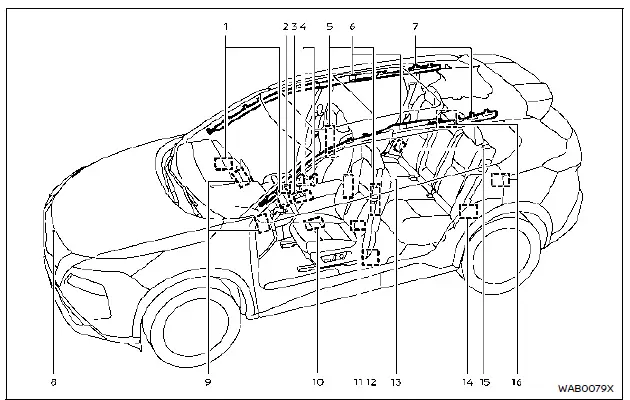
- Supplemental front-impact air bag modules (NISSAN Advanced Air Bags)
- Occupant classification system control unit
- Air bag Control Unit (ACU)
- Occupant classification sensors (weight sensors)
- Front seat-mounted side-impact supplemental air bag modules
- Roof-mounted curtain side-impact and rollover supplemental air bag inflators
- Roof-mounted curtain side-impact and rollover supplemental air bag modules
- Crash zone sensor
- Driver and front passenger supplemental knee air bags
- Front door pressure sensors (driver's side shown; passenger similar)
- Lap outer pretensioners (front seats)
- Seat belt with pretensioners (front seats)
- Front central seat-mounted side-impact supplemental air bag (if equipped)
- Satellite sensors (driver's side shown; passenger side similar)
- Rear outboard seat-mounted side-impact supplemental air bag modules
- Seat belt with pretensioners (rear outboard seats)
Basic information
WARNING
To ensure proper operation of the passenger’s Advanced Air Bag System, observe the following precautions.
- Do not allow rear-seat passengers to push or pull on the seatback pocket.
- Do not place loads heavier than 9.1 lbs (4 kg) on the seatback, head restraint, or inside the seatback pocket.
- Ensure nothing presses against the rear of the seatback, including a child restraint or cargo on the floor.
- Do not place any items under the front passenger seat.
- Make sure no objects are lodged between the seat cushion and center console or door.
- Verify that the front passenger seat does not touch the rear seat, dashboard or roof liner.
- Do not position the seat so far back that it contacts the rear seat, as this may trigger an air bag fault and illuminate the warning lights.
- If using a forward-facing child restraint in the front passenger seat, ensure it does not contact the dashboard, or the system may mistakenly enable the air bag.
- Check the front passenger air bag status light to confirm operating mode.
- If the status light does not function correctly, have the system inspected by a NISSAN dealer.
- Until proper operation is confirmed, seat all passengers in the rear seats.
Your Nissan Rogue is equipped with the NISSAN Advanced Air Bag System for both front seats. This system meets U.S. regulatory requirements and is allowed for use in Canada as well. All related warnings and instructions in this manual must be followed for safe operation.
The driver supplemental front-impact air bag is located in the steering wheel. The passenger front-impact air bag is mounted inside the instrument panel above the glove box.
These front air bags are designed to deploy during higher-severity frontal collisions, though they may also activate in other collisions with similar force levels.
They may not activate in all frontal crashes. Vehicle damage, or the lack of it, does not always indicate correct air bag behavior.
The NISSAN Advanced Air Bag System uses dual-stage inflators. It relies on the ACU, seat belt sensors, and occupant classification sensors to determine deployment force. For the front passenger, weight sensors also determine whether the air bag should activate. Depending on crash severity and seat belt use, only one air bag may deploy.
Under some conditions, the passenger air bag and the passenger knee air bag may automatically turn OFF. When this occurs, the air bag status light will illuminate. (See "Front passenger air bag and status light" for more details.)
If you have questions about the air bag system of your Nissan Rogue, contact a NISSAN dealer. If you need vehicle modifications due to a disability, NISSAN can also assist.
When a front air bag deploys, a loud noise may be heard along with the release of harmless smoke. Although not dangerous, the smoke may irritate the throat—fresh air is recommended for sensitive individuals.
Front air bags help cushion impact forces to the head and chest when combined with properly worn seat belts.
Although air bags can save lives, deployment may still cause abrasions or injuries. Air bags do not protect the lower body except for the knee air bags.
Seat belts must always be worn correctly, and front occupants must sit upright and positioned as far back as practical from the steering wheel or dashboard. Being too close during deployment increases injury risk.
The front air bags deflate shortly after deployment.
The front air bags operate only when the ignition is in the ON position.
After switching the ignition ON, the supplemental air bag warning light will illuminate for about 7 seconds and then turn off if the system is functioning properly.
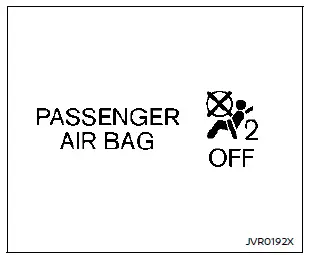
Front passenger air bag status light
Front passenger air bag and status light
WARNING
The front passenger air bag and knee air bag automatically switch OFF under certain conditions. Read this section carefully to understand proper operation.
Correct seating, seat belt use and appropriate child restraint installation are essential for optimal protection. Failure to follow these instructions increases the risk of injury in an accident.
Status light:
The front passenger seat of your Nissan Rogue is equipped with occupant classification sensors (weight sensors) that turn the front passenger air bag and front passenger knee air bag ON or OFF depending on the weight applied to the front passenger seat. The status of the front passenger air bag and front passenger knee air bag (ON or OFF) is shown by the front passenger air bag status light
 located on the map light. After the ignition switch is turned to the ON position, the front passenger air bag status light illuminates for about 7 seconds, then either turns off or remains illuminated depending on whether the front passenger seat is occupied. The light operates as follows:

In addition, certain objects placed on the front passenger seat may cause the light to behave in the same way, depending on their weight.
Front passenger air bag:
The front passenger air bag is designed to automatically turn OFF when the vehicle is operated under certain conditions, as allowed by U.S. regulations.
If the front passenger air bag is OFF, it will not deploy in a crash. The driver air bag and the other air bags in your vehicle are not affected by this particular system.
The purpose of this regulation is to help reduce the risk of injury or death from an inflating air bag to specific front passenger seat occupants, such as children, by requiring the passenger air bag to turn OFF automatically. Dedicated sensors are used to meet these requirements.
The occupant classification sensor in this vehicle is a weight sensor. It is designed to detect an occupant or objects on the seat by weight. For example, if a child is seated in the front passenger seat of the Nissan Rogue, the Advanced Air Bag System is designed to turn the passenger air bag OFF in accordance with regulations. Likewise, if a specified type of child restraint is installed on the seat, the combined weight of the restraint and the child can be detected and cause the air bag to turn OFF.
Front passenger seat adult occupants who are properly seated and using the seat belt as described in this manual should generally not cause the passenger air bag and front passenger knee air bag to turn OFF automatically. However, for small adults, the air bag may turn OFF if they shift their weight off the seat cushion (for example, by not sitting upright, sitting on the seat edge, or otherwise sitting out of position). Always sit properly and wear the seat belt correctly to get the most effective protection from the seat belt and supplemental air bag.
NISSAN recommends that pre-teens and children in a Nissan Rogue be properly restrained in a rear seat. NISSAN also recommends that suitable child restraints and booster seats be properly installed in a rear seating position. If this is not possible, the occupant classification sensors are designed to turn the front passenger air bag and front passenger knee air bag OFF for certain child restraints as required by regulations. Failure to properly secure a child restraint or to use the Automatic Locking Retractor (ALR) mode (child restraint mode) can allow the restraint to tip or move in a sudden stop or accident. This may also cause the passenger air bag and front passenger knee air bag to deploy in a crash when they should be OFF. (See "Child restraints" for proper use and installation.)
If the front passenger seat is not occupied, the passenger air bag and front passenger knee air bag are designed not to deploy in a crash. However, heavy objects placed on the seat may still trigger air bag deployment because their weight is detected by the occupant classification sensors. Other improper conditions could also cause deployment, such as a child standing on the seat or two children sharing the seat, contrary to the instructions in this manual. Always ensure that you and all passengers are properly seated and restrained.
In your Nissan Rogue, you can use the front passenger air bag status light to monitor when the front passenger air bag and front passenger knee air bag are automatically turned OFF.
If an adult is seated in the front passenger seat but the front passenger air bag status light is illuminated (indicating the front passenger air bag and front passenger knee air bag are OFF), the person may be a small adult or may not be seated correctly on the seat.
If a child restraint must be installed in the front seat, the front passenger air bag status light may or may not illuminate, depending on the child’s size and the type of child restraint used.
If the front passenger air bag status light is not illuminated (indicating that the air bag may deploy in a crash), the child restraint or seat belt may not be used correctly. Ensure that the child restraint is installed properly, the seat belt is routed correctly, and the occupant is positioned properly. If the front passenger air bag status light still does not illuminate, move the occupant or child restraint to a rear seat.
If the front passenger air bag status light will not illuminate even though you believe that the child restraint, seat belt, and occupant are correctly positioned, it is recommended that you have your vehicle inspected by a NISSAN dealer. A NISSAN dealer can verify system status using a special diagnostic tool. Until you confirm with your dealer that the air bag is operating correctly, relocate the occupant or child restraint to a rear seat.
The NISSAN Advanced Air Bag System and front passenger air bag status light may take a few seconds to recognize changes in passenger seat status. This delay is normal and does not indicate a malfunction.
If a malfunction occurs in the front passenger air bag system, the supplemental air bag warning light
 , located in the meters and gauges area, will illuminate (blinking or continuously lit). Have the system inspected. It is recommended you visit a NISSAN dealer for this service.
Normal operation:
To allow the occupant classification sensor system in your Nissan Rogue to correctly classify the front passenger based on weight, follow the precautions and steps below:
Precautions:
- Do not hang objects weighing more than 9.1 lbs (4 kg) on the seat or place them in the seatback pocket.
- Ensure that no child restraint or other object is pressing against the rear of the seatback.
- Make sure no rear passenger is pushing or pulling on the back of the front passenger seat.
- Ensure that the front passenger seat or seatback is not forced against any object on the seat or floor behind it.
- Do not place objects under the front passenger seat.
- Ensure that the front passenger seat head restraint does not contact the roof when the seat is adjusted.
Steps:
1. Adjust the seat as outlined in "Seats". Sit upright with your back against the seatback, centered on the seat cushion, with your feet comfortably on the floor.
2. Make sure there are no objects resting on your lap.
3. Fasten the seat belt as described in "Seat belts". The front passenger seat belt buckle status is monitored by the occupant classification system and used as an input to determine occupancy status, so it is strongly recommended that the front passenger always fasten their seat belt.
4. Remain in this position for about 30 seconds so that the system can classify the front passenger before the vehicle is driven.
5. Confirm proper classification by checking the front passenger air bag status light.
NOTE:
This vehicle's occupant classification sensor system generally keeps the classification locked while driving, so it is important to verify that the front passenger is correctly classified before moving the vehicle. However, the system may recalculate the occupant’s weight under certain conditions (both when driving and when stopped). The front passenger should continue to sit as outlined above.
Troubleshooting:
If you believe the front passenger air bag status light is incorrect:
1. If the light is ON with an adult occupying the front passenger seat:
- Occupant is a small adult – in this case, the front passenger air bag status light is functioning as intended, and the front passenger air bag and front passenger knee air bag are suppressed.
However, if the occupant is not a small adult, then one of the following conditions may be interfering with the weight sensors of your Nissan Rogue:
- Occupant is not sitting upright, leaning against the seatback, and centered on the seat cushion with feet comfortably on the floor.
- A child restraint or another object is pressing against the rear of the seatback.
- A rear passenger is pushing or pulling on the back of the front passenger seat.
- The front passenger seat or seatback is being forced against an object on the seat or floor behind it.
- An object is placed under the front passenger seat.
- An object is positioned between the seat cushion and the center console or door.
If the vehicle is moving, stop when safe. Check and correct any of the above issues.
Restart the vehicle and wait for 1 minute.
NOTE:
During the system check, the front passenger air bag status light will stay illuminated for about 7 seconds.
If the light remains ON after this period, the passenger should not ride in the front seat until the vehicle is inspected. It is recommended you visit a NISSAN dealer for this service.
2. If the light is OFF even though a small adult, child, or child restraint is occupying the front passenger seat:
Possible causes that may interfere with the weight sensors include:
– The small adult or child is not seated upright, centered, or leaning properly against the seatback with feet placed on the floor.
- The child restraint is not installed correctly.
- An object over 9.1 lbs (4 kg) is hanging on the seat or placed inside the seatback pocket.
- A child restraint or another object is pressing against the rear of the seatback.
- A rear passenger is pushing or pulling on the back of the front passenger seat.
- The front seat or seatback is forced against an item located on the seat or floor behind it.
- An object is placed under the front passenger seat.
- An object is between the seat cushion and the center console.
- The front passenger head restraint is touching the roof.
If the vehicle is moving, stop when it is safe. Check and correct any of these issues.
Restart the vehicle and wait for 1 minute.
NOTE:
During the system check, the front passenger air bag status light will remain illuminated for approximately 7 seconds.
If the light remains OFF after this, the small adult, child, or child restraint should be moved to a rear seat, and the vehicle should be inspected by a NISSAN dealer as soon as possible.
3. If the light is OFF with no passenger or objects on the front passenger seat, the vehicle should be checked by a NISSAN dealer as soon as possible.
Other materials:
Dtc/circuit Diagnosis. U2140-87 Can Comm Err (ecm)
DTC Description
DESCRIPTIONCAN (Controller Area Network) is a serial
communication line for real time applications. It is an on-Nissan Ariya
vehicle multiplex communication line with high data communication speed
and excellent error detection ability. Modern Nissan Ariya vehicle is
equipped ...
P0531 A/c Refrigerant Pressure Sensor
DTC Description
DTC DETECTION LOGIC DTC
CONSULT screen terms
(Trouble diagnosis content)
DTC detection condition
P0531
00
REFRIGERANT PRESS SENSOR A
(A/C refrigerant pressure sensor A circuit range/performance
Diagnosis condition
Engine running at idle
Signal (termin ...
B2720-05 Corner Sensor [rl]
DTC Description
DTC DETECTION LOGIC DTC CONSULT screen items (Trouble diagnosis content) DTC detection condition
B2720-05
CORNER SENSOR [RL]
(Corner sensor [rear left])
Diagnosis condition
When ignition switch is ON
Signal (terminal)
—
Threshold
Configuration of so ...