
Nissan Rogue (T33) 2021-Present Service Manual: Kr15ddt :: Symptom Diagnosis
Heater and Air Conditioning System Symptoms
Symptom Table
SYMPTOM TABLE
| Symptom | Reference Page | |
|---|---|---|
| A/C system does not come on. | Go to Trouble Diagnosis Procedure for A/C System. | Refer to Diagnosis Procedure (with automatic air conditioning system) or Diagnosis Procedure (with manual air conditioning system). |
| A/C system cannot be controlled. | Go to Self-diagnosis Function. | Refer to Work Flow (with automatic air conditioning system) or Work Flow (with manual air conditioning system). |
| Front air outlet does not change. | Go to Trouble Diagnosis Procedure for Mode Door Motor. | Refer to DTC Diagnosis Procedure (with automatic air conditioning system) or Diagnosis Procedure (with manual air conditioning system). |
| Mode door motor is malfunctioning. | ||
| Front discharge air temperature does not change (driver side). | Go to Trouble Diagnosis Procedure for Air Mix Door Motor LH. | Refer to DTC Diagnosis Procedure (with automatic air conditioning system) or Diagnosis Procedure (with manual air conditioning system). |
| Air mix door motor LH is malfunctioning. | ||
| Front discharge air temperature does not change (passenger side). | Go to Trouble Diagnosis Procedure for Air Mix Door Motor RH. | Refer to DTC Diagnosis Procedure (with automatic air conditioning system) or Diagnosis Procedure (with manual air conditioning system). |
| Air mix door motor RH is malfunctioning. | ||
| Rear discharge air temperature does not change. | Go to Trouble Diagnosis Procedure for Air Mix Door Motor (Rear). | Refer to DTC Diagnosis Procedure. |
| Air mix door motor (rear) is malfunctioning. | ||
| Intake door does not change. | Go to Trouble Diagnosis Procedure for Intake Door Motor. | Refer to DTC Diagnosis Procedure (with automatic air conditioning system) or Diagnosis Procedure (with manual air conditioning system). |
| Intake door motor is malfunctioning. | ||
| Front blower motor operation is malfunctioning. | Go to Trouble Diagnosis Procedure for Front Blower Motor. | Refer to Diagnosis Procedure (with automatic air conditioning system) or Diagnosis Procedure (with manual air conditioning system). |
| Magnet clutch does not engage. | Go to Trouble Diagnosis Procedure for Magnet Clutch. | Refer to Diagnosis Procedure (with automatic air conditioning system) or Diagnosis Procedure (with manual air conditioning system). |
| Insufficient cooling (front). | Go to Trouble Diagnosis Procedure for Insufficient Cooling. | Refer to Diagnosis Procedure (with automatic air conditioning system) or Diagnosis Procedure (with manual air conditioning system). |
| Insufficient cooling (rear). | Go to Trouble Diagnosis Procedure for Insufficient Cooling. | Refer to Diagnosis Procedure. |
| Insufficient heating (front). | Go to Trouble Diagnosis Procedure for Insufficient Heating. | Refer to Diagnosis Procedure (with automatic air conditioning system) or Diagnosis Procedure (with manual air conditioning system). |
| Insufficient heating (rear). | Go to Trouble Diagnosis Procedure for Insufficient Heating. | Refer to Diagnosis Procedure. |
| Noise. | Go to Trouble Diagnosis Procedure for Noise. | Refer to Symptom Table. |
| Both high- and low-pressure sides are too high. | Go to Trouble Diagnosis Procedure for Unusual Pressure. | Refer to Trouble Diagnosis For Unusual Pressure. |
| High-pressure side is too high and low-pressure side is too low. | Go to Trouble Diagnosis Procedure for Unusual Pressure. | Refer to Trouble Diagnosis For Unusual Pressure. |
| High-pressure side is too low and low-pressure side is too high. | Go to Trouble Diagnosis Procedure for Unusual Pressure. | Refer to Trouble Diagnosis For Unusual Pressure. |
| Both high- and low-pressure side sometimes becomes negative. | Go to Trouble Diagnosis Procedure for Unusual Pressure. | Refer to Trouble Diagnosis For Unusual Pressure. |
| Low-pressure side sometimes becomes negative. | Go to Trouble Diagnosis Procedure for Unusual Pressure. | Refer to Trouble Diagnosis For Unusual Pressure. |
| Low-pressure side becomes negative. | Go to Trouble Diagnosis Procedure for Unusual Pressure. | Refer to Trouble Diagnosis For Unusual Pressure. |
Refrigeration System Symptoms
Trouble Diagnosis For Unusual Pressure
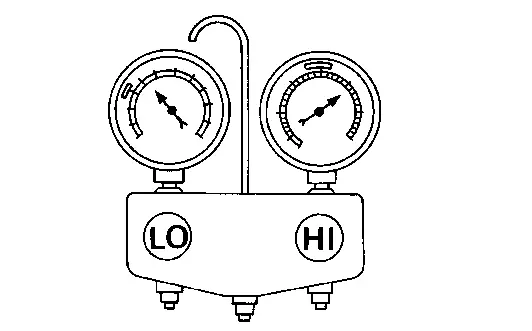
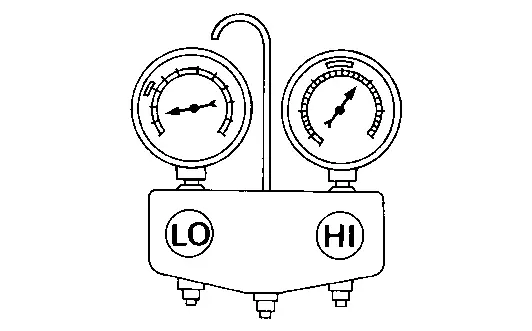
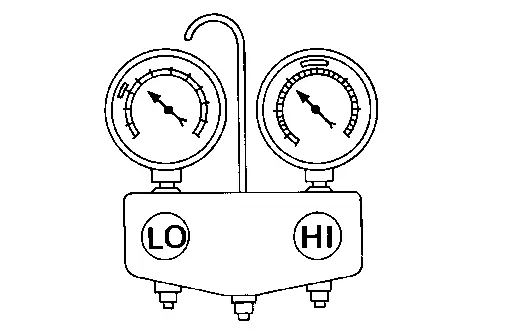
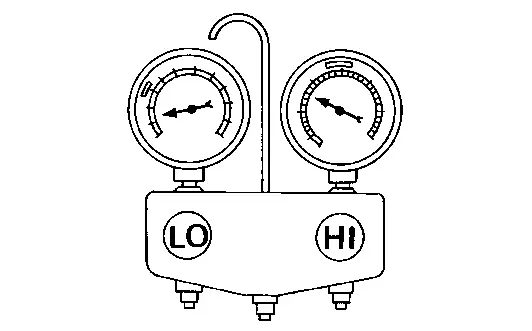
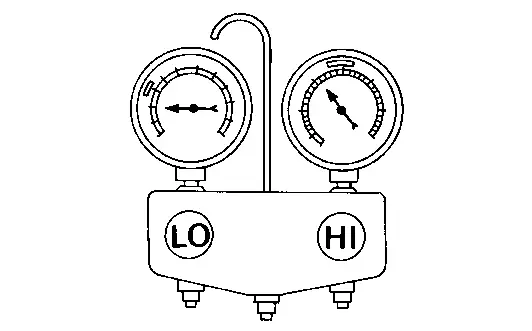
Diagnose using a manifold gauge whenever system’s high and/or low side pressure(s) is/are unusual. The marker above the gauge scale in the following tables indicates the standard (usual) pressure range. Refer to above table (Ambient air temperature-to-operating pressure table) since the standard (usual) pressure, however, differs from Nissan Ariya vehicle to vehicle.
Symptom Table
| Gauge indication | Refrigerant cycle | Probable cause | Corrective action |
|---|---|---|---|
|
Both high- and low-pressure sides are too high.
|
The pressure returns to normal soon after sprinkling water on condenser. | Overfilled refrigerant. | Collect all refrigerant, evacuate refrigerant cycle again, and then refill it with the specified amount of refrigerant. |
| Air flow to condenser is insufficient. |
Insufficient condenser cooling performance.
|
|
|
| When A/C compressor is stopped, a high-pressure reading quickly drops by approximately 196 kPa (2 kg/cm2, 28 psi). It then gradually decreases. | Air mixed in refrigerant cycle. | Collect all refrigerant, evacuate refrigerant cycle again, and then refill it with the specified amount of refrigerant. | |
|
Expansion valve opened too much (excessive flow of refrigerant). | Replace expansion valve. | |
|
High-pressure side is excessively high and low-pressure side is too low.
|
High-pressure pipe and upper side of condenser become hot, however, liquid tank does not become so hot. | Clogged or crushed high-pressure pipe located between compressor and condenser. | Repair or replace the malfunctioning parts. |
|
High-pressure side is too low and low-pressure side is too high.
|
|
Malfunction in A/C compressor system (insufficient A/C compressor pressure operation).
|
Replace A/C compressor. |
|
Both high- and low-pressure sides are too low.
|
|
Clogged expansion valve.
|
Eliminate foreign material from expansion valve, or replace it. |
|
Malfunction in inner liquid tank (clogged strainer). | Replace condenser & liquid tank. | |
| Evaporator becomes frosted. | Clogged or crushed low-pressure pipe. | Repair or replace malfunctioning parts. | |
| Malfunction in intake air temperature sensor. | Check intake sensor system. Refer to Diagnosis Procedure (AUTOMATIC AIR CONDITIONING), Diagnosis Procedure (MANUAL AIR CONDITIONING). | ||
| There is a small temperature difference between the high and low pressure pipes for refrigerant cycle. |
|
|
|
|
Low-pressure side sometimes becomes negative.
|
|
|
|
| Hunting in high-pressure side. | There is no temperature difference between high- and low-pressure sides. | Malfunctioning variable valve in A/C compressor. |
|
Noise
Symptom Table
| Symptom | Noise source | Probable cause | Corrective action |
|---|---|---|---|
| Unusual noise from A/C compressor when A/C is ON. | Inside of A/C compressor | Wear, breakage, or clogging of foreign material in inner parts. | Check A/C compressor oil. Refer to Inspection. |
| Magnet clutch | Contact of clutch disc with pulley. | Check clearance between clutch disc and pulley. | |
| A/C Compressor body | Loosened A/C compressor mounting bolts. | Check bolts for tightness. Refer to Exploded View. | |
| Unusual noise from cooler piping. | Cooler piping (pipe and flexible hose) | Improper installation of clip and bracket. | Check the installation condition of the cooler piping. Refer to Exploded View. |
| Unusual noise from expansion valve when A/C is ON. | Expansion valve | Shortage of refrigerant. |
|
| Wear, breakage, or clogging of foreign material in inner parts. | Eliminate foreign material from expansion valve, or replace it. | ||
| Unusual noise from belt. | — | Loosened belt | Check belt tension. Refer to Drive Belt. |
| Internal A/C compressor parts get locked | Replace A/C compressor. Refer to Removal and Installation. |
Other materials:
Removal and Installation. Automatic Back Door Lock and Close Switch Assembly
Removal and Installation
REMOVALRemove automatic back door lock and close switch
assembly and automatic back door close switch finisher. Refer to
Removal and Installation.
Remove automatic back door lock and close switch assembly fixing screws and then remove automatic back door lock and clos ...
Automatic Brake Hold. Symptom Diagnosis. Does Not Operate
Does Not Operate
Diagnosis Procedure
Automatic brake hold function does not operate when the operating conditions are satisfied.PERFORM SELF-DIAGNOSIS (CHASSIS CONTROL MODULE)
With CONSULT
Perform self-diagnosis for “CHASSIS CONTROL�.
Is DTC detected?
YES>>
Check the DTC.
With ...
Symptom Diagnosis. Reverse Interlock Door Mirror Does Not Operate
Diagnosis Procedure
CHECK DTC
Check DTC for Electric Shift control module. Refer to DTC Index.
Is the inspection result normal?
YES>>
GO TO 2.
NO>>
Repair replace the malfunctioning parts.
CHECK DTC
Check DTC for BCM. Refer to DTC Index.
Is the inspection result normal?
YES& ...