
Nissan Rogue (T33) 2021-Present Service Manual: Kr15ddt :: Periodic Maintenance
Idle Speed
IDLE SPEED : Periodic Maintenance
 With CONSULT
Check idle speed in “DATA MONITOR� mode of “ENGINE� using CONSULT.
 Without CONSULT
Check idle speed with Service $01 of GST.
| Idle speed: | IDLE SPEED : Service Data |
Ignition Timing
IGNITION TIMING : Periodic Maintenance
With CONSULT
Check Ignition timing in “DATA MONITOR� mode of “ENGINE� using CONSULT.
| Ignition timing : | IGNITION TIMING : Service Data |
Evaporative Emission System
EVAPORATIVE EMISSION SYSTEM : Inspection
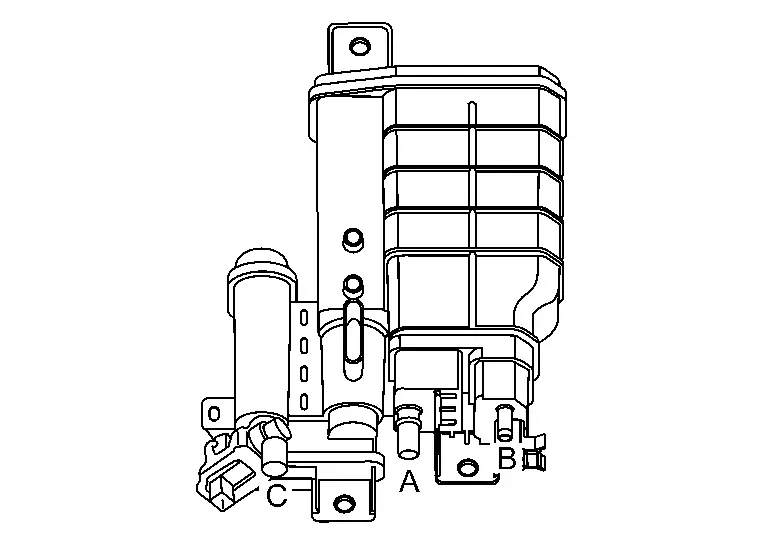
CHECK EVAP CANISTER
-
Block port (B).
-
Blow air into port (A) and check that it flows freely out of port (C).
-
Release blocked port (B).
-
Apply vacuum pressure to port (B) and check that vacuum pressure exists at the ports (A) and (C).
-
Block port (A) and (B).
-
Apply pressure to port (C) and check that there is no leakage.
INSPECTION END
Evap Leak Check
EVAP CANISTER : Periodic Maintenance
CAUTION:
-
Do not use compressed air or a high pressure pump.
-
Do not exceed 4.12 kPa (0.042 kg/cm2, 0.6 psi) of pressure in EVAP system.
 NOTE:
NOTE:
-
Do not start engine.
-
Improper installation of EVAP service port adapter [commercial service tool: (NI-41413-OBD)] to the EVAP service port may cause a leak.
WITH CONSULT
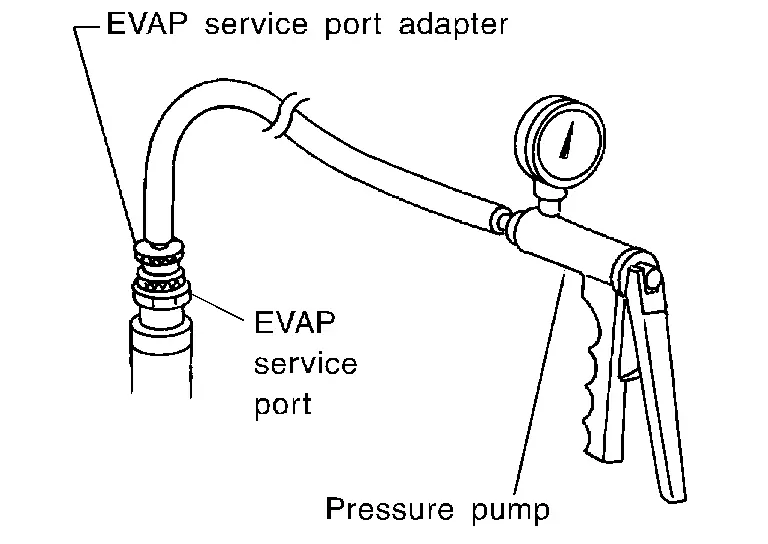
Install EVAP service port adapter [commercial service tool: (NI-41413-OBD)] and pressure pump to EVAP service port.
NOTE:
If vacuum delay valve does not have EVAP service port, remove vacuum delay valve and install EVAP service port [commercial service tool: (Part No. 149393S500)] instead.
Turn ignition switch ON.
Select the “EVAP SYSTEM CLOSE� of “WORK SUPPORT� mode with CONSULT.
Touch “START�. A bar graph (Pressure indicating display) will appear on the screen.
Apply positive pressure to the EVAP system until the pressure indicator reaches the middle of the bar graph.
Remove EVAP service port adapter [commercial service tool: (NI-41413-OBD)] and hose with pressure pump.
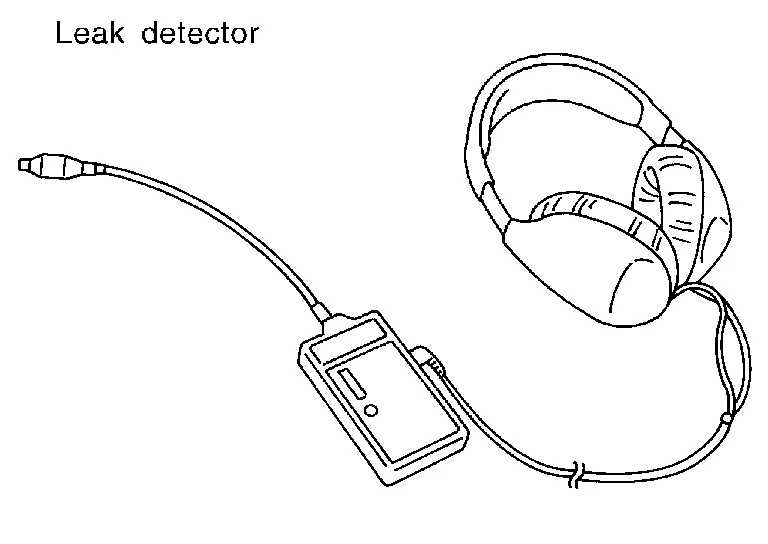
Locate the leak using a leak detector (commercial service tool). Refer to System Description.
WITHOUT CONSULT
Install EVAP service port adapter [commercial service tool: (NI-41413-OBD)] and pressure pump to EVAP service port.
NOTE:
If vacuum delay valve does not have EVAP service port, remove vacuum delay valve and install EVAP service port [commercial service tool: (Part No. 149393S500)] instead.
Apply battery voltage between the terminals of EVAP canister vent control valve to make a closed EVAP system.
To locate the leak, deliver positive pressure to the EVAP system until pressure gauge points reach 1.38 to 2.76 kPa (0.014 to 0.028 kg/cm2, 0.2 to 0.4 psi).
Remove EVAP service port adapter [commercial service tool: (NI-41413-OBD)] and hose with pressure pump.
Locate the leak using a leak detector (commercial service tool). Refer to System Description.
Positive Crankcase Ventilation
POSITIVE CRANKCASE VENTILATION : Periodic Maintenance
Start engine and let it idle.
Replace PCV valve from the rocker cover. Refer to Removal and Installation.
Connect PCV valve to PCV hose.
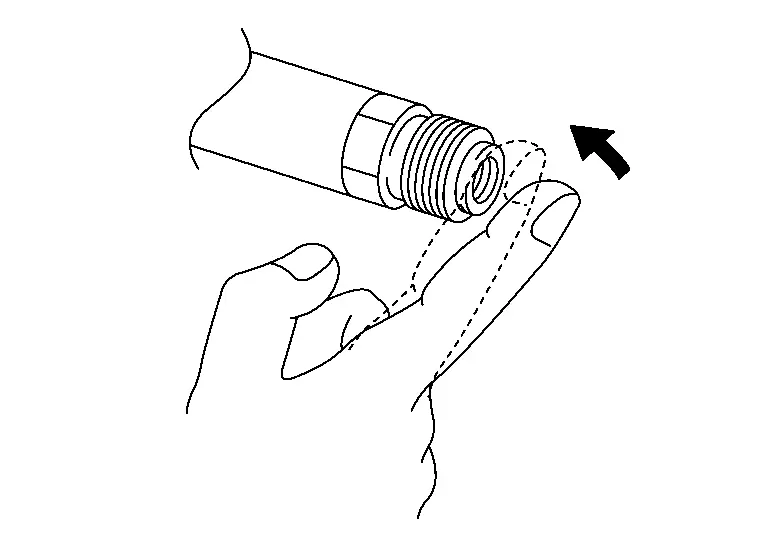
Block and unblock the air hole of PCV valve and check if a hissing noise can be heard from the air hole.
Is the inspection result normal?
YES >> INSPECTION END
NO >> Replace PCV valve. Refer to Removal and Installation.
Other materials:
Dtc/circuit Diagnosis. B2090-14 Nats Antenna Amp.
DTC Description
DTC DETECTION LOGIC DTC No.
CONSULT screen items
(Trouble diagnosis content) DTC detecting condition
B2090–14
NATS antenna amp.
(Nissan anti-theft system antenna amplifier)
Diagnosis condition
Work supports ‟Inside/outside antenna diagnosis�: activated
S ...
B2601-42 Memory Failure for Firmware Over the Air
DTC Description
DTC DETECTION LOGIC DTC No. CONSULT screen terms DTC detected condition
B2601-42
Memory failure for firmware over the air
Diagnosis condition
When ignition switch is ON.
Signal (terminal)
—
Threshold
Errors are detected in the memory for software auto ...
C1055-49 Can System
DTC Description
DTC DETECTION LOGIC DTC No.
CONSULT screen terms
(Trouble diagnosis content) DTC detection condition
C1055
49
CAN system
[Controller area network system]
1
Diagnosis condition
When ignition switch is ON.
When the power supply voltage is normal.
...