
Nissan Rogue (T33) 2021-Present Owner’s Manual & User Guide: Child safety
Basic information
WARNING
Do not allow children to play with the seat belts. Most seating positions in the Nissan Rogue are equipped with Automatic Locking Retractor (ALR) mode seat belts. If a seat belt becomes wrapped around a child's neck while the ALR mode is activated, the belt can tighten and cause serious injury or death — even if the vehicle is parked.
Unbuckle the seat belt immediately to free the child. If the belt cannot be unbuckled or is already unbuckled, cut the belt with a suitable tool (such as scissors or a knife) to release the child.
Children need adults to help protect them.
They must always be properly restrained.
In addition to the guidance in this manual, child safety recommendations are available from doctors, teachers, traffic safety offices, and community organizations. Every child is different, so take time to learn the safest way to transport your child in the Nissan Rogue.
There are three basic types of child restraint systems:
- Rear-facing child restraint
- Forward-facing child restraint
- Booster seat
The proper restraint depends on the child's size. Generally, infants up to about 1 year old and weighing less than 20 lbs (9 kg) should ride in a rear-facing child restraint. Forward-facing restraints are intended for children who have outgrown rear-facing restraints and are at least 1 year old.
Booster seats are used to help position the lap/shoulder belt correctly once a child has outgrown a forward-facing restraint.
WARNING
Infants and children require special protection. A vehicle seat belt may not fit them properly — the shoulder belt may rest too close to the face or neck, and the lap belt may not position correctly over the hips. In an accident, an improperly fitting belt could cause severe or fatal injuries.
Always use the proper child restraint system.
All U.S. states and Canadian provinces or territories require the use of approved child restraints for infants and small children.
A child restraint may be secured using either the LATCH (Lower Anchors and Tethers for CHildren) system or the vehicle’s seat belt. See “Child restraints� for more information.
NISSAN recommends that all pre-teens and children be restrained in the rear seat of the Nissan Rogue. Studies consistently show that properly restrained children are safer in the rear seat than in the front.
This is especially important because your vehicle includes a supplemental restraint system (air bag system) for the front passenger.
Infants
Infants up to at least 1 year old should be placed in a rear-facing child restraint.
NISSAN recommends that infants ride in child restraints that comply with Federal Motor Vehicle Safety Standards or Canadian Motor Vehicle Safety Standards. Choose a restraint that fits your Nissan Rogue properly and always follow the manufacturer’s installation and use instructions.
Small children
Children over 1 year old and weighing at least 20 lbs (9 kg) should remain in a rear-facing child restraint for as long as possible, up to the maximum height or weight limit allowed by the restraint. Once they outgrow these limits and are at least 1 year old, they should transition to a forward-facing child restraint with a harness. Follow the child restraint manufacturer's minimum and maximum weight and height guidelines.
NISSAN recommends that small children use child restraints that meet Federal Motor Vehicle Safety Standards or Canadian Motor Vehicle Safety Standards. Select a restraint that fits securely in your Nissan Rogue and follow all installation instructions carefully.
Larger children
Children should remain in a forward-facing child restraint with a harness until they reach the maximum height or weight limit of that restraint.
When a child outgrows the harness-equipped forward-facing restraint, NISSAN recommends using a booster seat to ensure proper seat belt fit in the Nissan Rogue. A booster seat raises the child so the shoulder belt lies correctly across the chest and mid-shoulder, and the lap belt fits snugly across the lower hips or upper thighs.
The shoulder belt must not cross the neck or face, and it should not slip off the shoulder. The lap belt must never rest on the abdomen.
A booster seat can only be used in seating positions equipped with a three-point seat belt. It must also fit the vehicle seat and be certified as meeting Federal or Canadian Motor Vehicle Safety Standards.
A booster seat should be used until the child can pass the seat belt fit test:
- Are the child's back and hips against the vehicle seatback?
- Can the child sit upright without slouching?
- Do the child’s knees bend comfortably over the seat edge with feet flat on the floor?
- Can the child wear the seat belt properly (lap belt low on the hips, shoulder belt across mid-chest and shoulder)?
- Is the child able to use a properly adjusted head restraint/headrest?
- Can the child remain in this position for the entire ride?
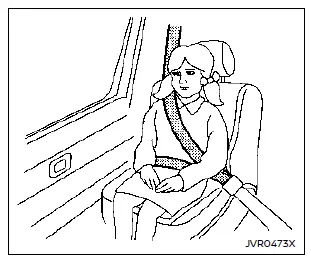
If any answer is “no,� the child should continue to use a booster seat with a three-point seat belt.
NOTE:
Local laws and regulations may differ. Always confirm that your child is using the correct restraint system before traveling.
WARNING
Never allow a child to stand or kneel on any seat, and never allow a child in the cargo area. Serious injury or death may occur in a sudden stop or collision.
Other materials:
Ecu Diagnosis Information. Bcm, Power Window Main Switch, Passenger Door Mirror Control Module
List of ECU Reference
ECU Reference
BCM
Values on the Diagnosis Tool
Reference Value (With Type A Meter)
Reference Value (With Type B Meter)
Fail-safe
DTC Inspection Priority Chart
DTC Index
Power window main switch
Reference Value
Passenger door mirror ...
Heated Oxygen Sensor 2 Heater
Component Inspection
CHECK HEATED OXYGEN SENSOR 2 HEATER
Turn ignition switch OFF.
Disconnect heated oxygen sensor 2 (HO2S2) harness connector.
Check resistance between HO2S2 terminals as per the following.
Heated oxygen sensor 2 Resistance
Terminal
1
2
5.4 - 7.3 Ω [ ...
Huile moteur
Vérification du niveau d'huile moteur
1. Garez le Nissan Rogue sur une surface plane et serrez fermement le frein de stationnement.
2. Laissez le moteur fonctionner jusqu’à ce qu’il atteigne sa température normale de fonctionnement.
3. Arrêtez le moteur et patientez au minimum 10 mi ...