
Nissan Rogue (T33) 2021-Present Owner’s Manual & User Guide: Basic information
Precautions on child restraints
WARNING
- Failure to follow the warnings and instructions for proper child restraint use and installation can lead to serious injury or death to a child or other passengers in a sudden stop or collision inside the Nissan Rogue:
- The child restraint must always be installed correctly. Follow all instructions provided by the child restraint manufacturer.
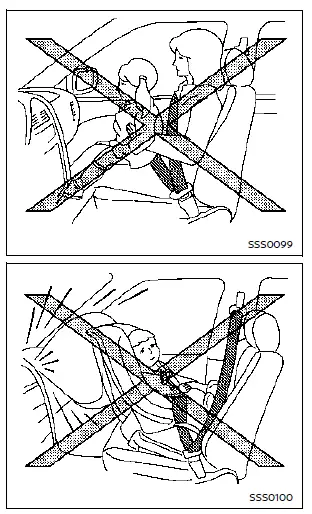
- Infants and children must never be held on anyone’s lap.
Even a strong adult cannot hold a child securely during a collision.
- Do not place a seat belt around both a child and another passenger.
- NISSAN recommends placing all child restraints in the rear seat of the Nissan Rogue. Studies show the rear seat is significantly safer for properly restrained children than the front seat. If a forward-facing child restraint must be placed in the front seat, refer to “Forward-facing child restraint installation using the seat belts�.
- Even with the NISSAN Advanced Air Bag System, never install a rear-facing child restraint in the front seat. A deploying air bag can severely injure or kill a child. Rear-facing restraints must only be used in the rear seat.
- Select a restraint that fits both the child and your Nissan Rogue. Some restraints may not be compatible with certain seating positions.
- Child restraint anchorages are designed only for loads from correctly fitted child restraints.
They must never be used to attach adult seat belts or other equipment. Misuse can damage the anchorages and prevent the child restraint from securing properly, increasing injury risk.
- Never use child restraint anchor points for adult seat belts or harnesses.
- Child restraints with a top tether strap should not be installed in the front passenger seat.
- After installing the child restraint, keep the seatback as upright as possible.
- Infants and children must always ride in an appropriate child restraint while in the vehicle.
- When the child restraint is not in use, secure it using the LATCH system or the seat belt. Unsecured objects can injure passengers or damage the vehicle during sudden stops.
CAUTION
A child restraint left inside a closed vehicle can become very hot. Check the seating surface and buckles before placing a child in the restraint.
The Nissan Rogue is equipped with a universal child restraint anchorage system called LATCH (Lower Anchors and Tethers for CHildren). Some child restraints include rigid or webbing-mounted attachments compatible with these anchors.
For details, see “Lower Anchors and Tethers for CHildren (LATCH) system�.
If your child restraint is not LATCH-compatible, you may use the vehicle seat belts instead.
Manufacturers offer various child restraints for infants and small children. When choosing a restraint, keep these points in mind:
- Select only restraints certified to Federal Motor Vehicle Safety Standard 213 or Canadian Standard 213.
- Ensure the child restraint is compatible with the vehicle seat and belt system in your Nissan Rogue.
- If compatible, place your child in the restraint and verify adjustments for a secure and safe fit.
Choose a restraint appropriate for your child’s height and weight. Always follow all recommended procedures.
- If the combined weight of the child and restraint is under 65 lbs (29.5 kg), you may use either the LATCH anchors or the seat belt (but never both at once).
- If the combined weight exceeds 65 lbs (29.5 kg), use the vehicle seat belt — not the lower anchors — to install the restraint.
- Always follow the child restraint manufacturer’s installation instructions.
All U.S. states and Canadian provinces or territories require infants and small children to be restrained in approved child restraints at all times while the vehicle is in motion.
Canadian law requires the top tether strap on forward-facing child restraints to be secured to the designated anchor point in the vehicle.
Other materials:
Dtc/circuit Diagnosis. U20c5-87 Can Comm Err (audio Amp.)
DTC Description
DESCRIPTIONCAN (Controller Area Network) is a serial
communication line for real time applications. It is an on-Nissan Ariya
vehicle multiplex communication line with high data communication speed
and excellent error detection ability. Modern Nissan Ariya vehicle is
equipped ...
C10b7-16 Parking Brake Power Supply
DTC Description
DTC DETECTION LOGIC DTC No.
CONSULT screen terms
(Trouble diagnosis content) DTC detection condition
C10B7
16
Parking brake power supply
(Parking brake power supply)
Diagnosis condition
When ignition switch ON.
Signal (terminal)
Ignition power supply
...
Lane Departure Warning (LDW)
Basic information
WARNING
Incorrect use of the LDW system may lead to serious injury. This feature only warns the driver of unintended lane departure; it does not steer the Nissan Rogue or prevent loss of control. The driver must always remain attentive.
The LDW system activates when driving a ...