
Nissan Rogue (T33) 2021-Present Service Manual: With Vdc :: Precaution. Precautions
Precautions
Precaution for Supplemental Restraint System (SRS) "AIR BAG" and "SEAT BELT PRE-TENSIONER"
The Supplemental Restraint System such as “AIR BAG� and “SEAT BELT PRE-TENSIONER�, used along with a front seat belt, helps to reduce the risk or severity of injury to the driver and front passenger for certain types of collisions.
Information necessary to service the system safely is included in the “SRS AIR BAG� and “SEAT BELT� sections of this Service Manual.
WARNING:
Always observe the following items for preventing accidental activation:
-
To avoid rendering the SRS inoperative, which could increase the risk of personal injury or death in the event of a collision that would result in air bag inflation, it is recommended that all maintenance and repair be performed by an authorized NISSAN/INFINITI dealer.
-
Improper repair, including incorrect removal and installation of the SRS, can lead to personal injury caused by unintentional activation of the system. For removal of Spiral Cable and Air Bag Module, see “SRS AIR BAG�.
-
Never use electrical test equipment on any circuit related to the SRS unless instructed to in this Service Manual. SRS wiring harnesses can be identified by yellow and/or orange harnesses or harness connectors.
PRECAUTIONS WHEN USING POWER TOOLS (AIR OR ELECTRIC) AND HAMMERS
WARNING:
Always observe the following items for preventing accidental activation:
-
When working near the Air Bag Diagnosis Sensor Unit or other Air Bag System sensors with the ignition/power switch ON or engine running, never use air or electric power tools or strike near the sensor(s) with a hammer. Heavy vibration could activate the sensor(s) and deploy the air bag(s), possibly causing serious injury.
-
When using air or electric power tools or hammers, always switch the ignition/power switch OFF, disconnect the 12V battery or batteries, and wait at least 3 minutes before performing any service.
Precaution for Procedure without Cowl Top Cover
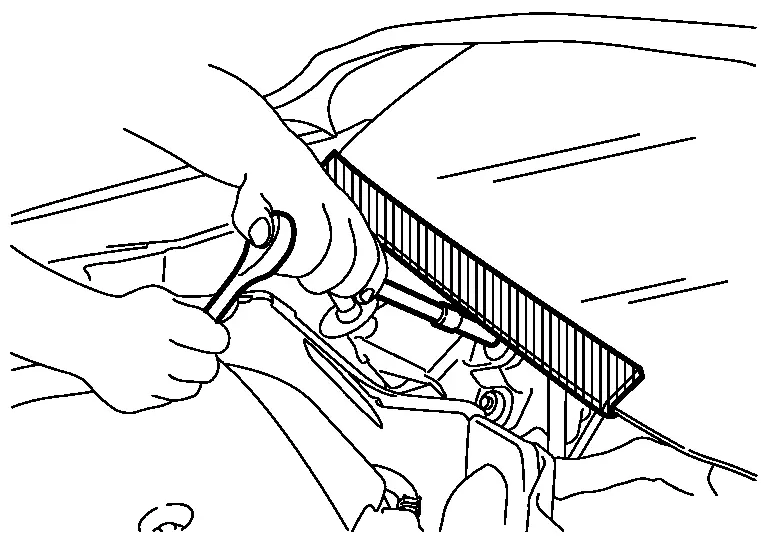
When performing the procedure after removing cowl top cover, cover the lower end of windshield with urethane, etc to prevent damage to windshield.
Precautions for Removing Battery Terminal
-
With the adoption of Auto ACC function, ACC power is automatically supplied by operating the Intelligent Key or remote keyless entry or by opening/closing the driver side door. In addition, ACC power is supplied even after the ignition switch is in the OFF position, i.e. ACC power is supplied for a certain fixed time.
-
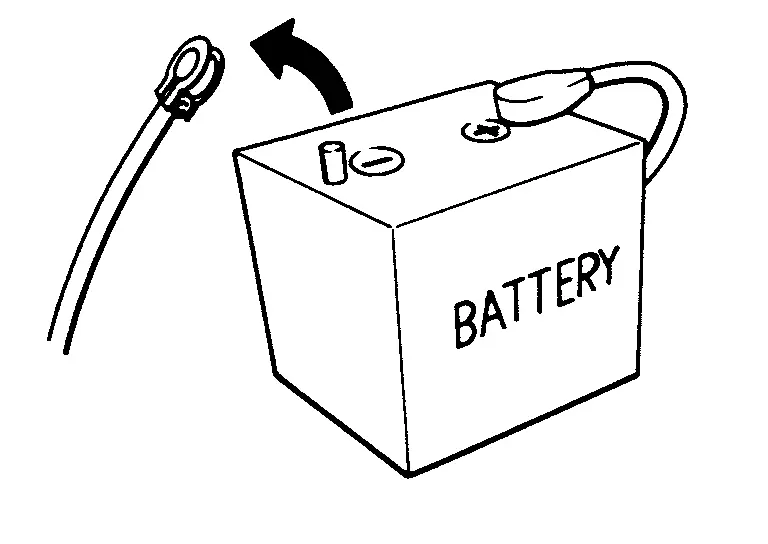
When disconnecting the 12V battery terminal, place the ignition switch in the OFF position before disconnecting the 12V battery terminal, observing “How to disconnect 12V battery terminal� described below.
 NOTE:
NOTE:
Some ECUs operate for a certain fixed time even after ignition switch is in the OFF position and ignition power supply is stopped. If the battery terminal is disconnected before ECU stops, accidental DTC detection or ECU data damage may occur.
-
For Nissan Ariya vehicles with the 2-batteries, be sure to connect the main battery and the sub battery before placing the ignition switch in the ON position.
NOTE:
If the ignition switch is in the ON position with any one of the terminals of main battery and sub battery disconnected, then DTC may be detected.
-
After installing the 12V battery, always check "Self Diagnosis Result" of all ECUs and erase DTC.
NOTE:
The removal of 12V battery may cause a DTC detection error.
HOW TO DISCONNECT 12V BATTERY TERMINAL
Disconnect 12V battery terminal according to instruction described below.
-
Open the hood.
-
Place the ignition switch in the ON position.
-
Place the ignition switch in the OFF position with the driver side door opened.
-
Get out of the Nissan Ariya vehicle and close the driver side door.
-
Wait at least 3 minutes.
CAUTION:
While waiting, never operate the Nissan Ariya vehicle such as locking, opening, and closing doors. Violation of this caution results in the activation of ACC power supply according to the Auto ACC function.
-
Remove 12V battery terminal.
CAUTION:
After installing 12V battery, always check self-diagnosis results of all ECUs and erase DTC.
Precaution for Brake System
WARNING:
Since dust covering the front and rear brakes has an affect on human body, the dust must be removed with a dust collector. Never splatter the dust with an air blow gun.
-
Brake fluid use refer to Fluids and Lubricants.
-
Never reuse drained brake fluid.
-
Never spill or splash brake fluid on painted surfaces. Brake fluid may seriously damage paint. Wipe it off immediately and wash with water if it gets on a painted surface.
-
Always confirm the specified tightening torque when installing the brake pipes.
-
After pressing the brake pedal more deeply or harder than normal driving, such as air bleeding, check each item of brake pedal. Adjust brake pedal if it is outside the standard value.
-
Never use mineral oils such as gasoline or light oil to clean. They may damage rubber parts and cause improper operation.
-
Always loosen the brake tube flare nut with a flare nut wrench.
-
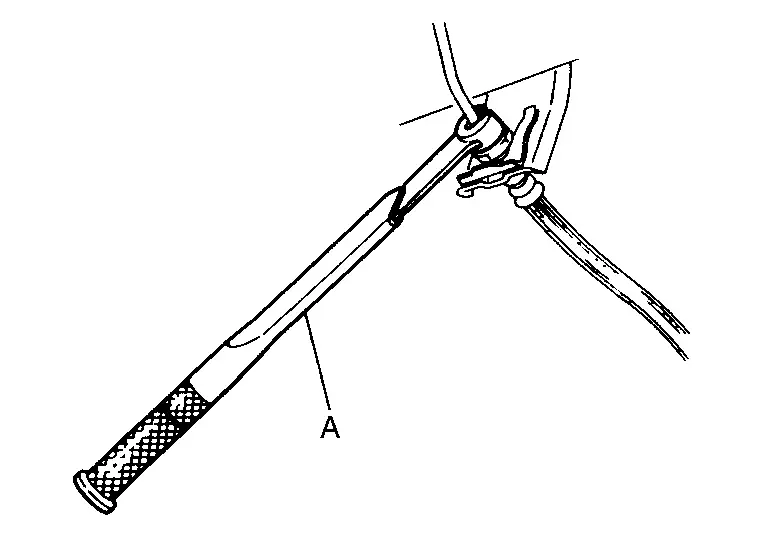
Tighten flare nut of brake tube to the specified torque using a flare nut torque wrench (A).
-
Ignition switch OFF and disconnect the ABS actuator and electric unit (control unit) harness connector or the 12V battery negative terminal before performing the work. Refer to Precautions for Removing Battery Terminal.
-
Check that no brake fluid leakage is present after replacing the parts.
Precaution for Brake Control System
-
Always perform a pre-driving check to drive the vehicle.
-
Always check speed and safety while driving the Nissan Ariya vehicle.
-
To operate CONSULT while driving, more than one person is required to be in the vehicle to avoid interference to driving and ensure safety.
-
Slight vibrations are felt on the brake pedal and the operation noises occur, when VDC function, TCS function, ABS function, EBD function, brake limited slip differential (BLSD) function, brake assist function, brake force distribution function, hill start assist function, or electric parking brake function operates. This is not a malfunction because it is caused by VDC function, TCS function, ABS function, EBD function, brake limited slip differential (BLSD) function, brake assist function, brake force distribution function, hill start assist function, or electric parking brake function that is normally operated.
-
When starting engine or when starting Nissan Ariya vehicle just after starting engine, brake pedal may vibrate or motor operating noise may be heard from engine compartment. This is normal condition.
-
Brake stopping distance may become longer than models without ABS function depending on the road conditions, when ABS function is operated on slippery road like rough road, gravel road or snowy road.
-
When a malfunction is indicated, always collect information from the customer about conditions of occurrence, estimate cause, and perform operation. Check brake booster operation, brake fluid level, and brake fluid leakage, as well as electrical system.
-
The optimum performance is achieved by control for VDC function, TCS function, ABS function, EBD function, brake limited slip differential (BLSD) function, brake assist function, brake force distribution function, hill start assist function, and electric parking brake function when all of brakes, suspensions and tires installed on the Nissan Ariya vehicle are the specified size and parts. Brake performance and controllability may be negatively affected when other parts than the specified are installed.
-
Brake stopping distance may become longer and steering stability may be negatively affected, when tires in different size and combination or other parts than the specified are used.
-
When a radio (including wiring), antenna and antenna lead line are located near ABS actuator and electric unit (control unit), a malfunction or improper operation may occur for the control of VDC function, TCS function, ABS function, EBD function, brake limited slip differential (BLSD) function, brake assist function, brake force distribution function, hill start assist function, and electric parking brake function.
-
When the following items are replaced by other parts than genuine parts or modified, ABS warning lamp, brake warning lamp and VDC warning lamp may turn ON, and the control may not operate normally for VDC function, TCS function, ABS function, EBD function, brake limited slip differential (BLSD) function, brake assist function, brake force distribution function, hill start assist function, and electric parking brake function.
-
Suspension component parts (shock absorber, spring, bushing and others)
-
Tire and wheel (other than the specified size)
-
Brake component parts (brake pad, disc rotor, brake caliper and others)
-
Engine component parts (ECM, muffler and others)
-
Body reinforcement component parts (rollover bar, tower bar and others)
-
-
When suspension, tire and brake related parts are excessively worn or deteriorated and the Nissan Ariya vehicle is driven, ABS warning lamp, brake warning lamp and VDC warning lamp may turn ON, and the control may not operate normally for VDC function, TCS function, ABS function, EBD function, brake limited slip differential (BLSD) function, brake assist function, brake force distribution function, hill start assist function, and electric parking brake function.
-
ABS warning lamp, brake warning lamp and VDC warning lamp may turn ON, when only front wheel or rear wheel is rotated using a free roller. This is not a malfunction, because it is caused by wheel speed difference between wheel that is rotated and wheel that is not rotated. In this case, perform self-diagnosis, check self-diagnosis results, and erase memory.
-
When power supply voltage is not normal, ABS warning lamp, brake warning lamp and VDC warning lamp turn ON. ABS actuator and electric unit (control unit) stops control for VDC function, TCS function, ABS function, EBD function, brake limited slip differential (BLSD) function, brake assist function, brake force distribution function, hill start assist function, and electric parking brake function. Ordinary brake operates. After power supply returns to normal, ABS warning lamp, brake warning lamp and VDC warning lamp turn OFF. The control becomes operative for VDC function, TCS function, ABS function, EBD function, brake limited slip differential (BLSD) function, brake assist function, brake force distribution function, hill start assist function, and electric parking brake function.
-
Brake pedal vibrates and operation sound occurs during sudden acceleration and cornering, when VDC function, TCS function, brake limited slip differential (BLSD) function, brake assist function, brake force distribution function, hill start assist function, and electric parking brake function. This is not a malfunction because it is caused by VDC function, TCS function, brake limited slip differential (BLSD) function, brake assist function, brake force distribution function, hill start assist function, and electric parking brake function that is operated normally.
-
VDC warning lamp may turn ON and VDC function, TCS function, brake limited slip differential (BLSD) function, brake assist function, brake force distribution function, hill start assist function, and electric parking brake function may not normally operate, when driving on a special road the is extremely slanted (bank in a circuit course). This is not a malfunction if the status returns to normal for VDC function, TCS function, brake limited slip differential (BLSD) function, brake assist function, brake force distribution function, hill start assist function, and electric parking brake function after the engine is started again. In this case, perform self-diagnosis, check self-diagnosis results, and erase memory.
-
A malfunction in yaw rate/side/decel G sensor system may be detected when the Nissan Ariya vehicle sharply turns during a spin turn, acceleration turn or drift driving while VDC function and TCS function are OFF (VDC OFF indicator lamp is in ON status). This is not a malfunction if the status returns to normal for VDC function and TCS function after the engine is started again. In this case, perform self-diagnosis, check self-diagnosis results, and erase memory.
Precautions for Harness Repair
-
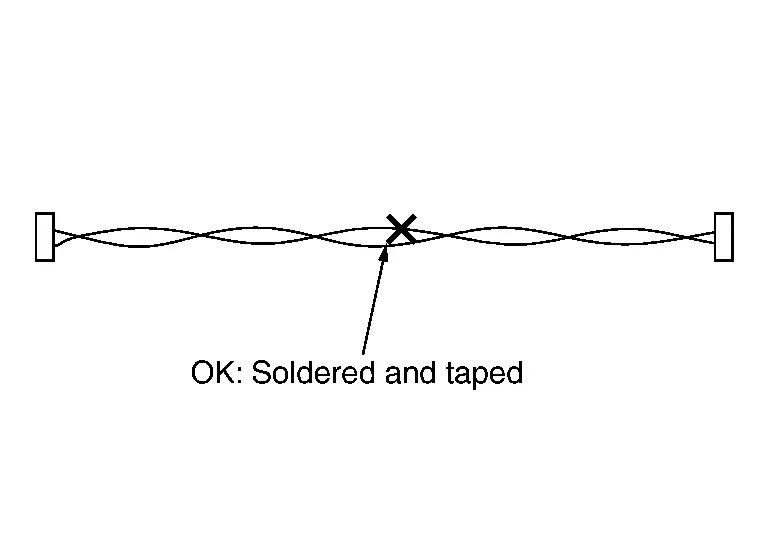
Solder the repaired area and wrap tape around the soldered area.
 NOTE:
NOTE:
A fray of twisted lines must be within 110 mm (4.33 in).
-
Bypass connection is never allowed at the repaired area.
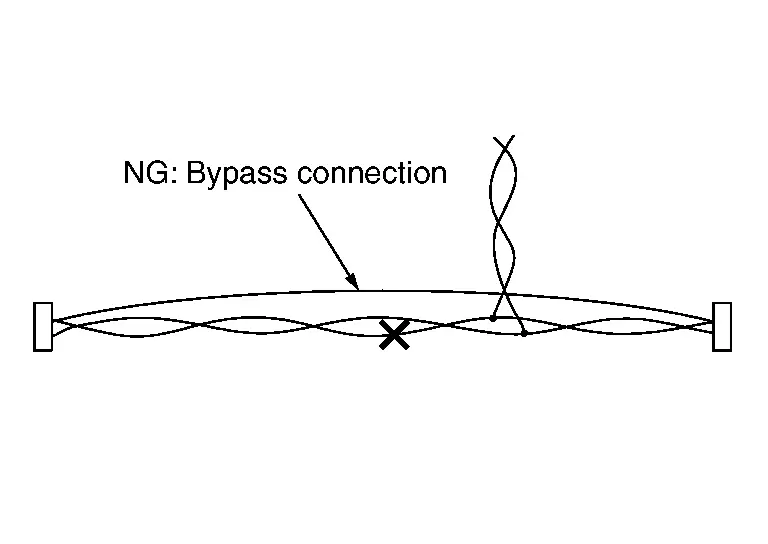 NOTE:
NOTE:
Bypass connection may cause CAN communication error. The spliced wire becomes separated and the characteristics of twisted line are lost.
-
Replace the applicable harness as an assembly if error is detected on the shield lines of CAN communication line.
Other materials:
U19b1-87 Can Comm Circuit
DTC Description
CAN COMMUNICATIONCAN (Controller Area Network) is a serial
communication line for real time applications. It is an on-Nissan Ariya
vehicle multiplex communication line with high data communication speed
and excellent error detection ability. Modern Nissan Ariya vehicle is
eq ...
Dtc/circuit Diagnosis. B2090-14 Nats Antenna Amp.
DTC Description
DTC DETECTION LOGIC DTC No.
CONSULT screen items
(Trouble diagnosis content) DTC detecting condition
B2090–14
NATS antenna amp.
(Nissan anti-theft system antenna amplifier)
Diagnosis condition
Work supports ‟Inside/outside antenna diagnosis�: activated
S ...
P1098 Humidity Temperature Sensor
DTC Description
DTC DETECTION LOGIC DTC
CONSULT screen terms
(Trouble diagnosis content)
DTC detection condition
P1098
00
Humidity temperature sensor
(Humidity temperature sensor Range/Performance)
Diagnosis condition
Engine cold start
Signal (terminal)
�
T ...