
Nissan Rogue (T33) 2021-Present Owner’s Manual & User Guide: Vehicle loading information
Basic information
WARNING
- Riding in a cargo area is extremely dangerous. In a collision, passengers in such areas are far more likely to be seriously injured or killed.
- Do not allow passengers in any area of the vehicle not equipped with proper seats and seat belts.
- Ensure all occupants are seated properly and wearing seat belts at all times.
Terms
It is important to understand the following loading-related terms before carrying cargo in your vehicle, including the Nissan Rogue:
- Curb Weight — actual weight of the vehicle including fluids, tools, spare tire, and equipment, but excluding passengers and cargo.
- GVW — curb weight plus combined passenger and cargo weight.
- GVWR — maximum allowable total weight of the unloaded vehicle, passengers, luggage, hitch, trailer tongue load, and optional equipment.
- GAWR — maximum load limit for the front or rear axle.
- GCWR — maximum combined weight of the vehicle, cargo, passengers, and trailer.
- Vehicle Capacity Weight / Load Limit — maximum weight of cargo and occupants combined, listed on the Tire and Loading Information label.
- Cargo Capacity — the allowable cargo weight after subtracting occupant weight from the load limit.
Vehicle load capacity
Basic information
Do not exceed the load limit marked as "The combined weight of occupants and cargo" on the Tire and Loading Information label. Also, do not exceed the "Seating Capacity" listed on the label for your Nissan Rogue.
To get "the combined weight of occupants and cargo", add the weight of all occupants, then add the total luggage weight. Examples are shown in the following illustration.
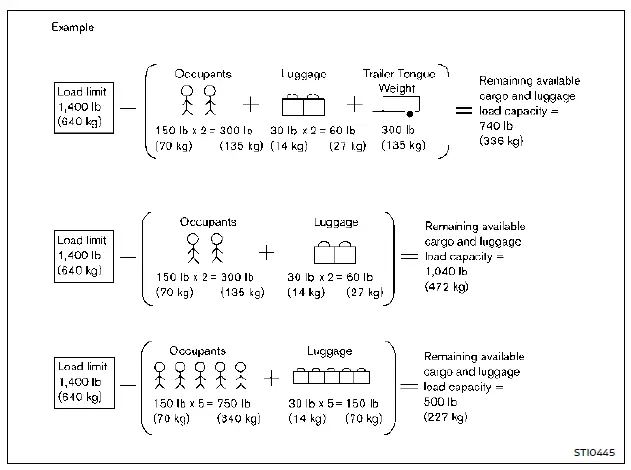
Steps For Determining Correct Load Limit
1. Locate the statement "The combined weight of occupants and cargo should never exceed XXX kg or XXX lbs" on your vehicle's placard.
2. Determine the combined weight of the driver and passengers that will be riding in your vehicle.
3. Subtract the combined weight of the driver and passengers from XXX kg or XXX lbs.
4. The resulting figure equals the available amount of cargo and luggage load capacity. For example, if the XXX amount equals 1400 lbs. and there will be five 150 lb. passengers in your vehicle, the amount of available cargo and luggage load capacity is 650 lbs. (1400 − 750 (5 x 150) = 650 lbs) 5. Determine the combined weight of luggage and cargo being loaded on the vehicle. That weight may not safely exceed the available cargo and luggage load capacity calculated in Step 4.
6. If your vehicle will be towing a trailer, load from your trailer will be transferred to your vehicle.
Consult this manual to determine how this reduces the available cargo and luggage load capacity of your vehicle.
Before driving a loaded vehicle, always confirm that you do not exceed the Gross Vehicle Weight Rating (GVWR) or the Gross Axle Weight Rating (GAWR) for your vehicle. This is especially important for maintaining safe handling and stability in a Nissan Rogue.
Also check that the tires are inflated to the proper pressures. Refer to the Tire and Loading Information label for the correct values.
Securing the load
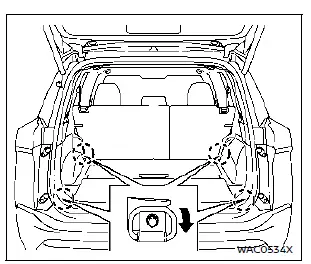
The cargo area of the Nissan Rogue includes luggage hooks as shown. These hooks can be used to secure cargo with ropes or straps to help keep items in place.
Do not apply a total load of more than 22 lbs. (10 kg) to a single metal floor hook when securing cargo.
WARNING
- Properly secure all cargo with ropes or straps to prevent items from sliding or shifting. Do not stack cargo higher than the seatbacks. In sudden braking or a collision, unsecured items could cause injury.
- The child restraint top tether strap may be damaged by contact with cargo. Secure all items in the cargo area to avoid damaging the tether strap, which is essential for child safety.
- Do not load your vehicle beyond the GVWR or the front and rear GAWR limits. Exceeding these limits may cause parts of your Nissan Rogue to fail, increase the risk of tire damage, or negatively affect vehicle handling—potentially leading to loss of control.
Loading tips
- The GVW must not exceed the GVWR or GAWR as listed on the F.M.V.S.S./C.M.V.S.S. certification label.
- Avoid loading the front and rear axles to their maximum GAWR simultaneously, as this would exceed the total GVWR.
WARNING
- Always secure all cargo to prevent items from shifting. Keeping cargo below the height of the seatbacks reduces the risk of injury in sudden stops or collisions.
- Do not exceed the GVWR or GAWR limits. Overloading your Nissan Rogue can damage components, affect handling, and increase braking distances.
- Overloading can shorten the life of your tires and your vehicle, and may also cause unsafe handling or longer stopping distances. Excessive load may lead to premature tire failure and could cause a serious accident. Failures caused by overloading are not covered by the vehicle’s warranty.
Measurement of weights
Secure all loose items to prevent weight shifts that may affect vehicle balance. When fully loaded, drive your Nissan Rogue to a scale and weigh the front and rear axles individually. Ensure neither axle load exceeds its GAWR.
The sum of the axle loads must not exceed the GVWR. If any weight limit is exceeded, remove or reposition items until all values fall within the allowed ratings shown on the certification label.
Other materials:
Flasher
CONSULT Function (BCM - FLASHER)
DATA MONITORNOTE:
The following table includes information (items)
inapplicable to this Nissan Ariya vehicle. For information (items)
applicable to this vehicle, refer to CONSULT display items.
Monitor item
[Unit] Description
Hazard switch
[Off/On]
...
Basic Inspection. Configration (intelligent Key Unit)
Description
Vehicle specification needs to be written with CONSULT because it is not written after replacing the Intelligent Key unit.The
configuration requires network connection. CONSULT connects to network
and then it downloads the configuration data from the server. Then
CONSULT writes th ...
Removal and Installation. Front Seat Belt
Exploded View
Anchor bolt
Retaining washer
Seat belt adjuster RH
Seat belt adjuster LH
Adjuster cover RH
Adjuster cover LH
Shoulder anchor RH
Shoulder anchor LH
Spacer
Seat belt pre-tensioner retractor RH
Seat belt pre-tensioner retractor L ...