
Nissan Rogue (T33) 2021-Present Service Manual: Periodic Maintenance :: Wheel Alignment
Inspection
DESCRIPTION
Measure wheel alignment under unladen conditions.
 NOTE:
NOTE:
“Unladen conditions� means that fuel, engine coolant, and lubricant are full. Spare tire, jack, hand tools and mats are in designated positions.
PRELIMINARY CHECK
Check the following:
-
Tires for improper air pressure and wear. Refer to Exploded View.
-
Road wheels for runout.
Refer to Inspection. -
Wheel bearing axial end play.
Refer to following:-
2WD: Refer to Inspection.
-
AWD: Refer to Inspection.
-
-
Shock absorber operation.
-
Each mounting point of axle and suspension for looseness and deformation.
-
Each of lower link, upper link, rear suspension member, suspension arm and shock absorber for cracks, deformation, and other damage.
-
Nissan Ariya Vehicle height (posture).
GENERAL INFORMATION AND RECOMMENDATIONS
-
A four-wheel thrust alignment should be performed.
-
This type of alignment is recommended for any NISSAN/INFINITI Nissan Ariya vehicle.
-
The four-wheel “thrust� process helps ensure that the vehicle is properly aligned and the steering wheel is centered.
-
The alignment rack itself should be capable of accepting any NISSAN/INFINITI Nissan Ariya vehicle.
-
The rack should be checked to ensure that it is level.
-
-
Make sure the machine is properly calibrated.
-
Your alignment equipment should be regularly calibrated in order to give correct information.
-
Check with the manufacturer of your specific equipment for their recommended Service/Calibration Schedule.
-
ALIGNMENT PROCESS
IMPORTANT:
Use only the alignment specifications listed in this Service Manual.
-
When displaying the alignment settings, many alignment machines use “indicators�: (Green/red, plus or minus, Go/No Go). Never use these indicators.
-
The alignment specifications programmed into your machine that operate these indicators may not be correct.
-
This may result in an ERROR.
-
-
Most camera-type alignment machines are equipped with both “Rolling Compensation� method and optional “Jacking Compensation� method to “compensate� the alignment targets or head units. “Rolling Compensation� is the preferred method.
-
If using the “Rolling Compensation� method, after installing the alignment targets or head units, push or pull on the rear wheel to move the Nissan Ariya vehicle. Do not push or pull on the vehicle body.
-
If using the “Jacking Compensation� method, after installing the alignment targets or head units, raise the Nissan Ariya vehicle and rotate the wheels 1/2 turn both ways.
NOTE:
Do not use the “Rolling Compensation� method if you are using sensor-type alignment equipment.
-
Follow all instructions for the alignment machine you're using for more information.
-
Adjustment
CAMBER
-
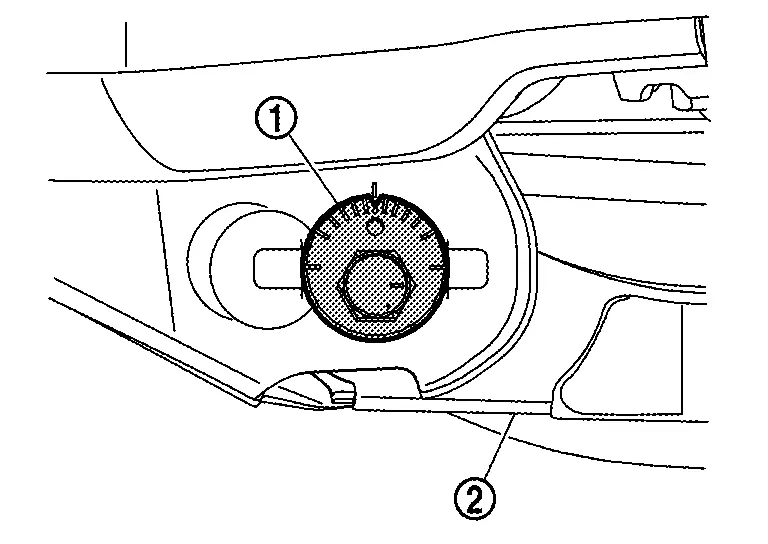
If camber is exceeds the standard value, adjust with adjusting bolt
 in front lower link
  .
.
Camber: Refer to Wheel Alignment. CAUTION:
-
When tightening the nut firmly and checking the torque, use a wrench to prevent the turning of the bolt.
-
After adjusting camber, be sure to check toe-in.
-
If camber is not still within the specification, inspect and replace any damaged or worn suspension parts.
-
TOE-IN
-
If toe-in is exceeds the standard value, adjust with adjusting bolt
in rear lower link .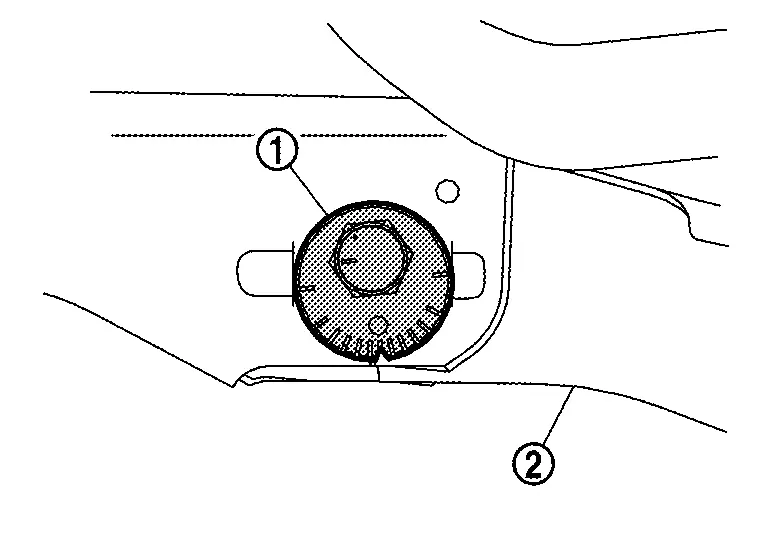
Toe-In: Refer to Wheel Alignment. CAUTION:
-
Be sure to adjust equally on right and left side with adjusting bolt.
-
When tightening the nut firmly and checking the torque, use a wrench to prevent the turning of the bolt.
-
If toe-in is not still within the specification, inspect and replace any damaged or worn suspension parts.
-
-
After toe-in adjustment, adjust neutral position of steering angle sensor. Refer to Description.
Other materials:
Poste de conduite
Le poste de conduite du Nissan Rogue regroupe les commandes de conduite, d’assistance et de confort. Familiarisez-vous avec l’emplacement des commandes au volant et des systèmes d’aide avant de rouler, surtout si vous changez de version ou de finition.
Commande Direction assistée* (m ...
Wiring Diagram. Harness Layout
Outline
Harness Layout
Refer to Harness Layout.
Engine Room Harness
Harness Layout
ENGINE ROOM HARNESS - BATTERY VIEW (WITH ProPILOT Assist 2.1)Refer to Harness Layout.ENGINE ROOM HARNESS - BATTERY VIEW (WITHOUT ProPILOT Assist 2.1)Refer to Harness Layout.ENGINE ROOM HARNESS - CABIN VIEW (WITH Pr ...
Lower Anchors and Tethers for CHildren (LATCH) system
LATCH system anchor location
Basic information
Your Nissan Rogue includes special anchor points for LATCH-compatible child restraints. This system may also be called ISOFIX. With LATCH, you do not need to use the seat belt unless the combined weight of the child plus restraint exceeds 65 lbs ( ...