
Nissan Rogue (T33) 2021-Present Service Manual: Oil Pan (lower)
Exploded View
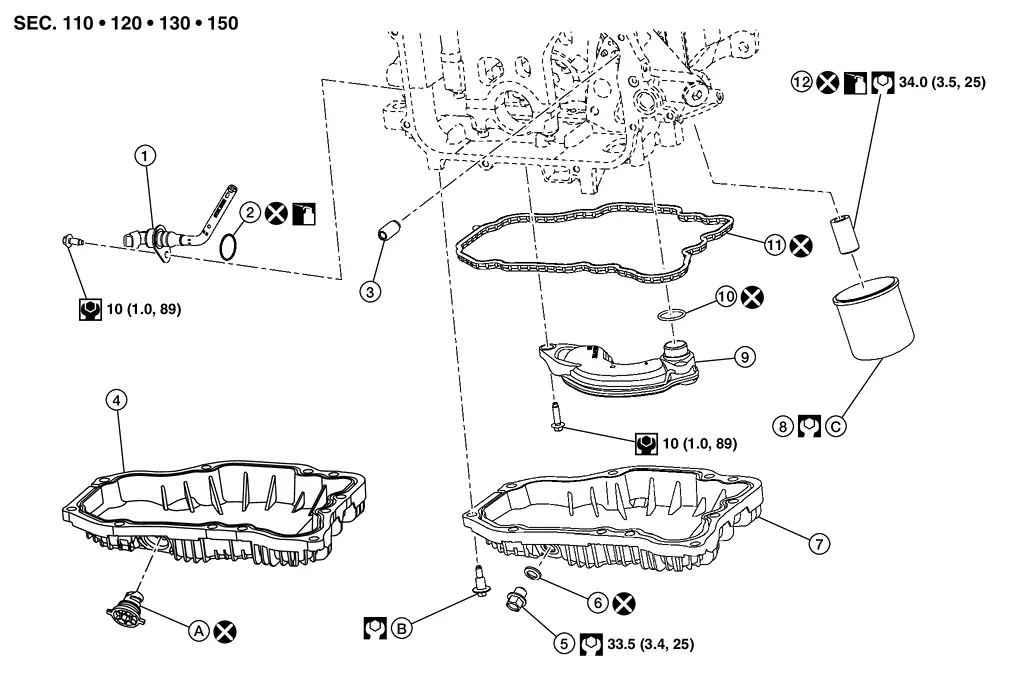
| 1. | Engine oil level sensor | 2. | O-ring 1 | 3. | Relief valve |
| 4. | Oil pan (lower) (With plastic drain plug) | 5. | Drain plug | 6. | Drain plug washer |
| 7. | Oil pan (lower) (With metal drain plug) | 8. | Oil filter | 9. | Oil strainer |
| 10. | O-ring 2 | 11. | Oil pan gasket | 12. | Oil filter stud |
| A. | Comply with the installation procedure when tightening. Refer to Removal and Installation. | B. | Comply with the installation procedure when tightening. Refer to Removal and Installation. | C. | Comply with the installation procedure when tightening. Refer to Removal and Installation. |
 |
: Always replace after every disassembly. | ||||
 |
: N·m (kg-m, in-lb) | ||||
 |
: N·m (kg-m, ft-lb) | ||||
 |
: Should be lubricated with oil. | ||||
Removal and Installation
With metal drain plug
REMOVAL
WARNING:
To avoid the danger of being scalded, never drain the engine oil when the engine is hot.
Remove engine under cover. Refer to Removal and Installation.
Drain engine oil. Refer to Draining.
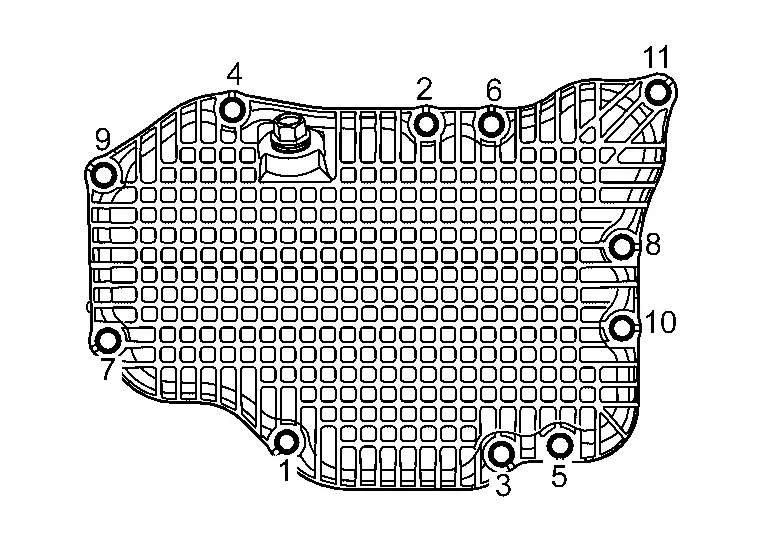
Loosen mounting bolts in reverse order as shown in the figure, and then remove oil pan (lower).
INSTALLATION
CAUTION:
-
Do not reuse o-ring 1 and o-ring 2.
-
Do not reuse drain plug washer.
-
Do not reuse oil pan gasket.
Tighten bolts in numerical order as shown in the figure.
| Oil pan (lower) bolts | ||
| First tighten |
: 2.96 N·m (0.30 kg-m, 26 in-lb) | |
| Second tighten |
: 8.33 N·m (0.85 kg-m, 74in-lb) | |
Install drain plug.
-
Refer to the figure of components of former page for installation direction of washer. Refer to Exploded View.
CAUTION:
Do not reuse drain plug washer.
Install in the reverse order of removal after this step.
With plastic drain plug
REMOVAL
WARNING:
To avoid the danger of being scalded, never drain the engine oil when the engine is hot.
Remove engine under cover. Refer to Removal and Installation.
Drain engine oil. Refer to Draining.
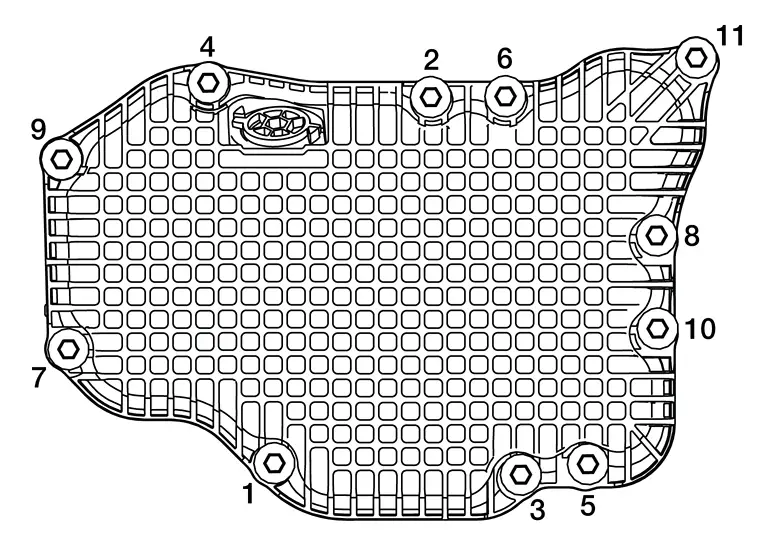
Loosen mounting bolts in reverse order as shown in the figure, and then remove oil pan (lower).
INSTALLATION
CAUTION:
-
Do not reuse o-ring 1 and o-ring 2.
-
Do not reuse drain plug.
-
Use genuine drain plug.
-
Do not reuse oil pan gasket.
Tighten bolts in numerical order as shown in the figure.
| Oil pan (lower) bolts | ||
| First tighten |
: 2.96 N·m (0.30 kg-m, 26 in-lb) | |
| Second tighten |
: 8.33 N·m (0.85 kg-m, 74in-lb) | |
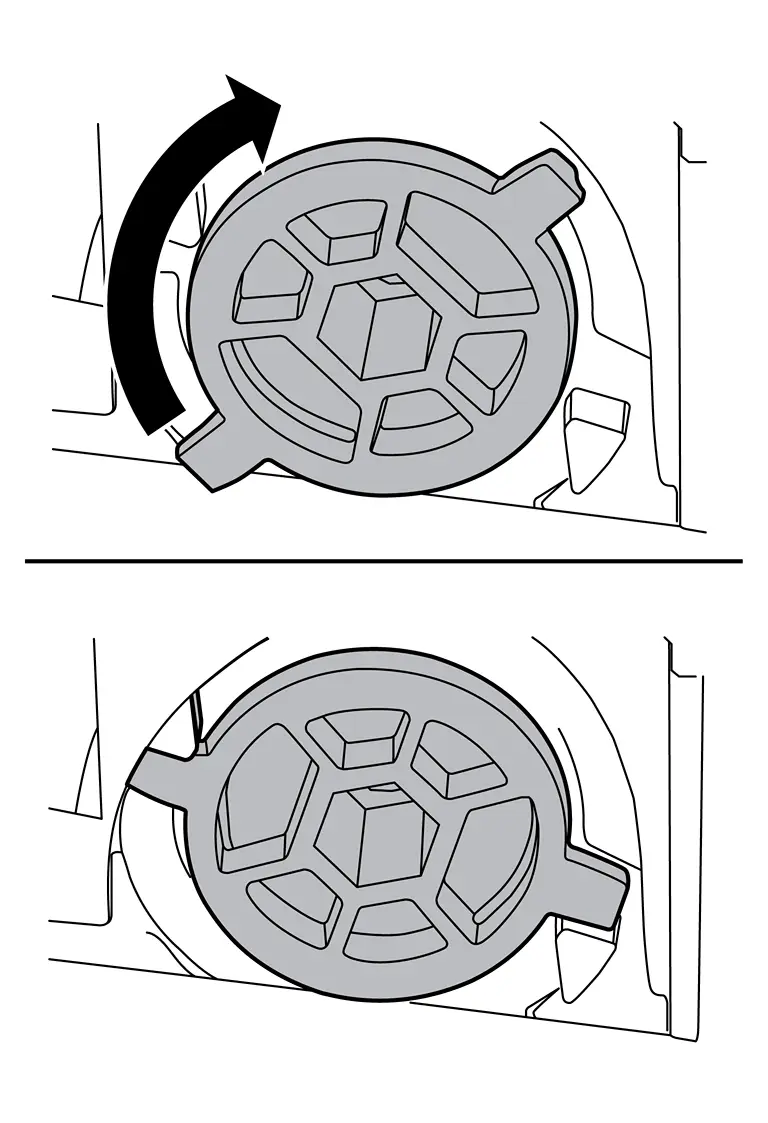
Using suitable tool, install new drain plug and tighten to the lock position in the direction shown.
CAUTION:
-
Do not reuse drain plug.
-
Use genuine drain plug.
| Tightening torque | 3 N·m (0.31 kg-m, 27 in-lb | |
Install in the reverse order of removal after this step.
Inspection
INSPECTION AFTER REMOVAL
Clean oil strainer portion if any object attached.
INSPECTION AFTER INSTALLATION
Check the engine oil level and adjust engine oil. Refer to Inspection.
Start engine, and check there is no leakage of engine oil.
Stop engine and wait for 10 minutes.
Check the engine oil level again. Refer to Inspection.
Other materials:
P1098 Humidity Temperature Sensor
DTC Description
DTC DETECTION LOGIC DTC
CONSULT screen terms
(Trouble diagnosis content)
DTC detection condition
P1098
00
Humidity temperature sensor
(Humidity temperature sensor Range/Performance)
Diagnosis condition
Engine cold start
Signal (terminal)
�
T ...
Towing your vehicle
Basic information
When towing your vehicle, always follow local towing laws and regulations. Using incorrect equipment or improper towing procedures can damage your vehicle. Professional service operators typically know the proper towing methods.
To prevent accidental damage, NISSAN recommends ha ...
Ssg Branch Line Circuit
Diagnosis Procedure
CHECK CONNECTOR
Turn the ignition switch OFF.
Disconnect the battery cable from the negative terminal.
Check the terminals and connectors of the sub starter & generator
for damage, bend and loose connection (unit side and connector side).
Is the inspect ...