
Nissan Rogue (T33) 2021-Present Owner’s Manual & User Guide: Jump starting. Push starting
To start your engine using a booster battery, carefully follow the instructions and precautions below.
WARNING
- Incorrect jump starting can cause a battery explosion, leading to severe injury or death.
- Explosive hydrogen gas is always present around the battery. Keep all sparks, flames, and cigarettes away.
- Avoid contact with battery fluid. It is corrosive sulfuric acid that can cause severe burns. If contact occurs, immediately flush with water.
- Keep the battery out of the reach of children.
- Use only a 12-volt booster battery. An incorrect voltage can severely damage your vehicle.
- Wear eye protection and remove all metal jewelry before working near a battery. Do not lean over the battery during jump starting.
- Do not attempt to jump start a frozen battery — it can explode.
- Your vehicle has an automatic cooling fan that may turn on at any time. Keep hands and tools away.
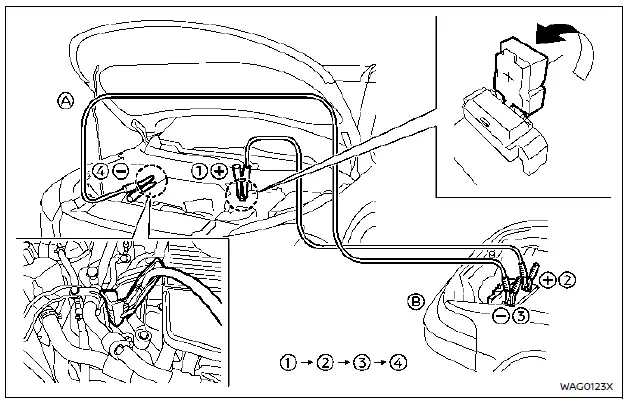
WARNING
Always follow the instructions below. Failure to do so may damage the charging system or cause personal injury.
Jump starting procedure
1. If the booster battery is in another vehicle, position the two vehicles (A and B) so the batteries are close together. Do not allow the vehicles to touch.
2. Apply the parking brake.
3. Push the park button to select the P (Park) position.
4. Turn off all unnecessary electrical systems (lights, heater, A/C, etc.).
5. Connect the jumper cables in the exact order shown (1 → 2 → 3 → 4).
CAUTION
- Always connect positive (+) to positive (+), and negative (−) to a solid engine ground — never to the battery’s negative terminal in your vehicle.
- Ensure the jumper cables do not touch any moving engine parts or other metal surfaces.
6. Start the booster vehicle (B) and let its engine run for a few minutes.
7. Hold the booster vehicle engine speed at around 2,000 rpm, then attempt to start vehicle A.
CAUTION
- Do not crank the engine for more than 10 seconds. If it does not start, turn the ignition OFF and wait at least 10 seconds before trying again.
- If the engine still does not start: - Turn off the booster vehicle engine, - Turn ignition OFF, - Open and close the driver’s door once (with the Intelligent Key inside), - Keep the door closed and wait at least 3 minutes without performing any operations. Then repeat the procedure from step 6.
8. Once your engine starts, carefully disconnect the jumper cables in reverse order (4 → 3 → 2 → 1).
Push starting
Do NOT attempt to push start the vehicle.
CAUTION
- CVT models cannot be push-started or tow-started. Attempting to do so may severely damage the transmission.
- Vehicles equipped with a three-way catalyst can be damaged if push-started.
- Never attempt to start the vehicle by towing it. If the engine starts suddenly, the vehicle may surge forward and collide with the tow vehicle.
Other materials:
U214f-57 Mac Comm Error (bcm)
Without Propilot Assist 2.1
DTC Description
DTC DETECTION LOGIC DTC
CONSULT screen terms
(Trouble diagnosis content) DTC detection condition
U214F
57
CAN comm err (BCM)
[Controller area network communication error (Body control module)]
Diagnosis condition
—
Signal (t ...
P268a Fuel Injector Calibration
DTC Description
DTC DETECTION LOGIC DTC No.
CONSULT screen terms
(Trouble diagnosis content) DTC detection condition
P268A
00
Fuel injector calibration
(Fuel Injector Calibration Not Learned/Programmed)
Diagnosis condition
Fuel injector offset learning in progress
Signal ( ...
ProPILOT Assist Systems Overview
Each ProPILOT Assist function on the Nissan Rogue is designed to support the driver in a specific way while driving, adding comfort and helping with routine tasks on the road.
Below is an overview of these ProPILOT Assist features. For complete operating details, refer to the indicated sections of t ...