
Nissan Rogue (T33) 2021-Present Owner’s Manual & User Guide: Cockpit
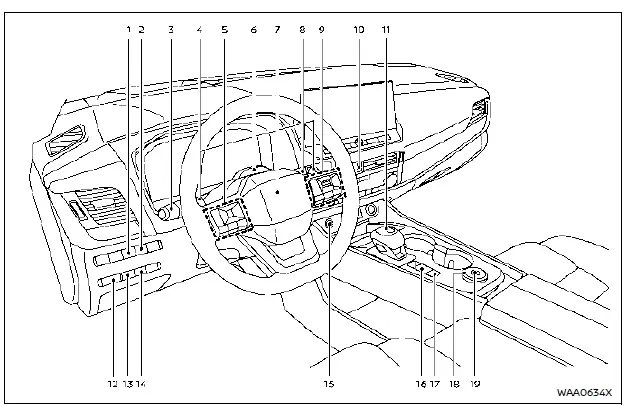
- Steering Assist switch* (models with ProPILOT Assist), a feature often highlighted in the Nissan Rogue for easier highway driving
- Head Up Display (HUD) switch*
- Headlight and turn signal switch located in a standard position as used in the Nissan Rogue
- Paddle shifters
- Steering-wheel-mounted controls (left
side)
- Audio control**
- Vehicle information display control found on many Nissan Rogue models
- Driver monitor camera*
- Steering wheel
- Horn
- Wiper and washer switch
- Steering-wheel-mounted controls
(right side)
- Cruise control switches*
- ProPILOT Assist switch*
- Bluetooth Hands-Free Phone System switches**
- Voice Recognition system switch**
- Siri Eyes Free**
- Hazard indicator flasher switch commonly referenced in the Nissan Rogue safety features
- Shift lever
- Continuously Variable Transmission (CVT)
- Instrument brightness control
- Idling Stop OFF switch
- Power liftgate switch*
- Push-button ignition switch
- Parking brake switch
- Automatic brake hold switch
- Drive Mode Selector***
- Hill descent control switch*
*: if so equipped
**: See the separate NissanConnect
Owner's Manual.
***: The Drive Mode Selector illustrated is
for the AWD model. On the 2WD model,
the shape and location differ.
Other materials:
Intelligent Forward Collision Warning (I-FCW)
Basic information
WARNING
Failure to follow the warnings and instructions for proper use of the I-FCW system on the Nissan Rogue could result in serious injury or death.
The I-FCW system helps alert the driver before a potential collision but cannot prevent one. The driver must remain attentive, ...
Main Line Between Avm and Sonar Circuit
Diagnosis Procedure
CHECK HARNESS CONTINUITY (OPEN CIRCUIT)
Turn the ignition switch OFF.
Disconnect the battery cable from the negative terminal.
Disconnect the following harness connectors.
Around view monitor control unit
Sonar control unit
ADAS control unit 2
...
Seat belts with pretensioners (front and
rear outboard seats)
WARNING
The pretensioners cannot be
reused after activation. They must
be replaced together with the
retractor and buckle as a complete
unit in your Nissan Rogue.
If the vehicle becomes involved in
a collision but a pretensioner is
not activated, be sure to have the
pretensioner system ins ...