
Nissan Rogue (T33) 2021-Present Owner’s Manual & User Guide: Heated seats
WARNING
Do not use, or allow others to use, the seat heater if you or the occupant cannot monitor seat temperature or have reduced ability to feel pain in areas contacting the seat. This may result in serious injury.
CAUTION
- Running the heater while the engine is off may drain the battery.
- Avoid using the seat heater for extended periods or when the seat is empty.
- Do not place thick or insulating materials such as blankets or cushions on the seat, as heat may build up excessively.
- Do not place heavy objects or puncture the seat with sharp items to prevent damage to the heating element.
- Wipe away any spilled liquids immediately with a dry cloth.
- Do not use gasoline, thinner, or similar chemicals to clean the seat.
- If the heated seat malfunctions, turn it off and have the system inspected by a NISSAN dealer.
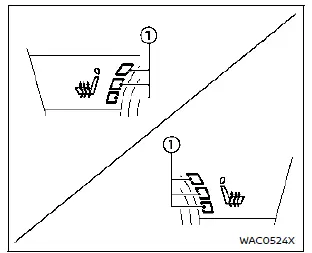
Front
Rear (if so equipped)
The front and rear seats (if equipped) are warmed by built-in heaters. The switches are located on the instrument panel and on the rear of the center console, allowing independent operation for each seat in the Nissan Rogue.
Operation with switch
1. Start the engine.
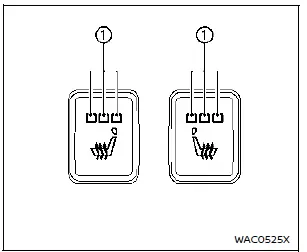
2. Push the heated seat switch and select your preferred heat level.
- Press once for high heat.
- Press twice for medium heat.
- Press three times for low heat.
- The indicator light 1 on the switch illuminates to show the selected level.
3. To turn the heater off, press the switch until the indicator light goes out.
The system uses a control module that automatically regulates heat output according to the chosen setting, maintaining passenger comfort.
The indicator light remains illuminated as long as the heater is on.
After the interior warms or before leaving the vehicle, be sure to turn off the seat heaters to conserve battery power.
Other materials:
Systèmes de rétroviseurs du Nissan Rogue
Rétroviseur intérieur central
Réglez l'inclinaison de votre rétroviseur intérieur afin d'obtenir une vision parfaite de la lunette arrière de votre Nissan Rogue avant chaque départ.
Modèle manuel anti-éblouissement : En conduite nocturne, basculez le levier vers l'arrière (posi ...
Fuel information
Basic information
Use unleaded regular gasoline with an octane rating of at least 87 AKI (Anti-Knock Index) number (Research octane number 91), as recommended for your Nissan Rogue.
CAUTION
Using a fuel other than specified may negatively affect the emission control system of your Nissan Rogue an ...
System temporarily unavailable
When any of the following alerts appear on the vehicle information display of the Nissan Rogue, a chime will sound and the I-BSI system will automatically switch off for safety.
"Unavailable Slippery Road":
Occurs when the VDC system (except traction control) or the ABS is actively operating.
...