
Nissan Rogue (T33) 2021-Present Owner’s Manual & User Guide: Tire pressure
Tire Pressure Monitoring System (TPMS)
Your Nissan Rogue is equipped with the TPMS, which monitors tire pressure on all wheels except the spare. If the “Tire Pressure Low – Add Air� warning appears, one or more tires are significantly under-inflated.
The TPMS activates only when driving above 16 MPH (25 km/h) and may not detect a sudden pressure loss, such as a rapid flat.
Tire inflation pressure
Regularly check all tires — including the spare — and especially before long trips. Nissan Rogue tire pressure specifications can be found on the Tire and Loading Information label on the driver-side center pillar under “Cold Tire Pressure.�
- Normal air loss occurs naturally over time.
- Tires may also lose air abruptly after impacts with potholes, curbs, or objects.
Check pressures only when the tires are COLD — after parking for 3+ hours, or driving less than 1 mile (1.6 km).
The Nissan Rogue also features TPMS with Easy Fill Tire Alert, providing visual and audible signals when inflating tires to the correct pressure.
Incorrect tire pressure can reduce tire life, negatively affect handling, and compromise safety.
WARNING
- Driving with improperly inflated tires may cause sudden failure and a loss of control.
- The Gross Vehicle Weight Rating (GVWR) is shown on the certification label. The maximum load capacity is indicated on the Tire and Loading Information label. Do not exceed the loading limit of your Nissan Rogue. Overloading can lead to premature tire failure and unsafe handling.
- Before long trips or when carrying heavy cargo, check that all tires are inflated to the recommended COLD pressure.
- Refer to “Important Tire Safety Information� in the Warranty Information Booklet for additional tire safety details.
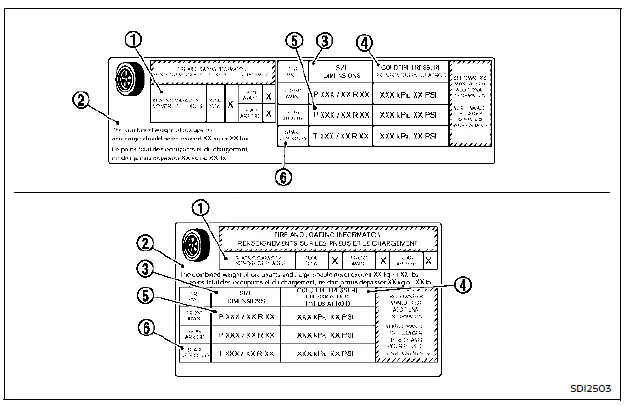
Tire and Loading Information label
- The seating capacity shows the maximum number of occupants your Nissan Rogue can safely carry.
- Vehicle load limit — see “Vehicle loading information� for full details.
- Original size indicates the factory-installed tire dimensions for the Nissan Rogue.
- Cold tire pressure: Inflate the tires to this value only when they are cold. “Cold� means the vehicle has been parked 3+ hours or driven less than 1 mile (1.6 km). This pressure offers the best balance of tire wear, comfort, handling and overall performance for the Nissan Rogue.
- Tire size — see “Tire labeling�.
- Spare tire size or compact spare tire size.
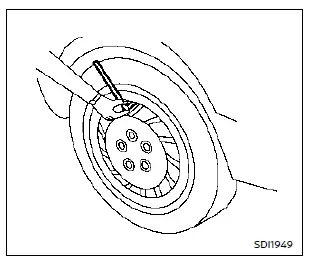
Checking the tire pressure
1. Remove the valve stem cap from the tire.
2. Press the pressure gauge squarely onto the valve stem. Do not force the stem or tilt the gauge to avoid air loss. If you hear air escaping, reposition the gauge for a proper seal.
3. Remove the gauge.
4. Read the pressure and compare it with the recommended values on the Tire and Loading Information label of the Nissan Rogue.
5. Add air as required. If you add too much, briefly press the valve core using the gauge tip to release excess air. Repeat the measurement and adjust accordingly.
6. Reinstall the valve stem cap.
7. Check the remaining tires, including the spare, to maintain proper pressure for safe Nissan Rogue operation.
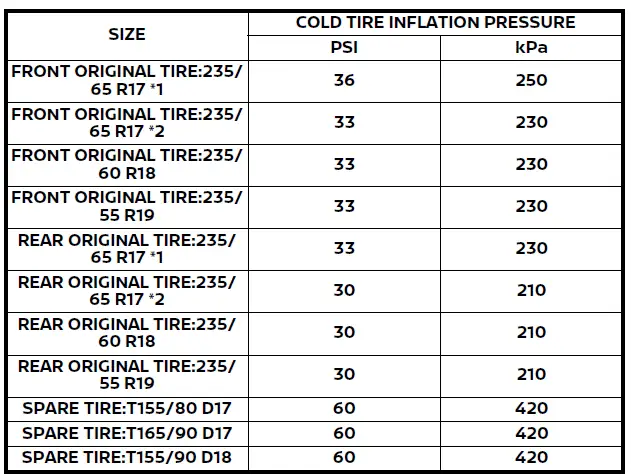
Other materials:
Removal and Installation. Brake Pedal
Without Propilot Assist 2.1
Exploded View
Brake pedal assembly
Snap pin
Brake pedal pad
Stop lamp switch
Clevis pin
: N·m (kg-m, ft-lb)
: Apply multi-purpose grease.
: Always replace after every disassem ...
Removal and Installation. Washer Fluid Level Switch
Removal and Installation
CAUTION:
When washer fluid level switch is removed, washer fluid
may come out, so be prepared with a container to receive the fluid and
never allow fluid to be sprinkled.
REMOVALTurn the steering wheel to improve access to the washer tank near the front tire (RH).
Re ...
Dtc/circuit Diagnosis. Washer Fluid Level Switch Circuit
Diagnosis Procedure
CHECK WASHER FLUID LEVEL SWITCH CIRCUIT
Disconnect combination meter and washer fluid level switch connector.
Check continuity between combination meter harness connector and washer fluid level switch harness connector.
Combination meter Washer fluid level switch C ...