
Nissan Rogue (T33) 2021-Present Owner’s Manual & User Guide: Tire chains
WARNING
If tire chains are used on the Nissan Rogue, ensure they provide adequate clearance from suspension and body components.
Incorrect chain selection or improper installation can cause damage to brakes, suspension or other components, risking a crash. Use only the recommended chains or an approved equivalent.
- PEERLESS SUPER Z6 SZ-429
Local laws may restrict tire chain use. Always verify requirements before installation. Select chains that match the tire size of your Nissan Rogue and follow the manufacturer’s installation instructions.
Only SAE Class S chains should be used on models with limited clearance. These chains are designed for vehicles like the Nissan Rogue that require minimum spacing between the tire and surrounding components.
Install chains only on the front wheels, never on the rear wheels or on a TEMPORARY USE ONLY spare tire.
Do not use tire chains on dry pavement, as this may cause mechanical damage due to excessive stress.
Changing wheels and tires

Tire rotation
Follow the recommended tire rotation interval specified in the maintenance schedule to ensure even wear on the Nissan Rogue.
As soon as possible, tighten the wheel nuts to the specified torque using a torque wrench.
Wheel nut tightening torque: 80 ft-lb (108 N·m)
Wheel nuts must always remain tightened to specification, including at each rotation interval.
WARNING
- Retighten wheel nuts after driving 600 miles (1,000 km), including after a flat tire repair.
- The spare tire should not be included in tire rotation.
- Refer to “Important Tire Safety Information� for additional guidance.
- After rotating the tires, adjust pressures with a gauge — do not rely on Easy-Fill Tire Alert for post-rotation adjustments.
- For proper Easy-Fill Tire Alert operation after rotation, the sensors must be reset and re-registered. It is recommended to have this service performed by a NISSAN dealer.
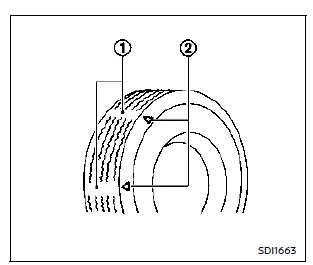
- Wear indicator
- Wear indicator location mark
Tire wear and damage
WARNING
- Tires should be inspected regularly for wear, cracks, bulging or embedded objects. Replace damaged tires promptly to maintain safe operation of the Nissan Rogue.
- Factory-original tires have built-in tread wear indicators. When they become visible, the tires must be replaced.
- Tires age over time. Have all tires, including the spare, inspected if they are more than six years old.
- Improper service of the spare tire may cause injury. For spare-tire service, it is recommended to visit a NISSAN dealer.
Replacing wheels and tires
When replacing a tire on the Nissan Rogue, always use the same size, tread pattern, speed rating and load-carrying capacity as originally equipped. (See the "Specifications" section for recommended tire and wheel types.)
WARNING
- Using tires not recommended for the Nissan Rogue, or mixing different brands, constructions (bias, bias-belted, radial), or tread patterns, can negatively affect braking, handling, VDC operation, ground clearance, tire-to-body clearance, chain fitment, and even headlight aim. These issues may lead to a loss of control and serious injury.
- On 2WD Nissan Rogue models, if only two tires are replaced, the new tires must be installed on the rear axle to help maintain stability. Installing new tires on the front axle may result in loss of control in certain driving conditions.
- If wheels are changed, always replace them with wheels that have the same offset. Incorrect wheel offset can cause uneven wear, poor handling, or interference with the brake system, possibly affecting stopping distance and safety.
- Since the spare tire on the Nissan Rogue is not equipped with TPMS, mounting the spare or replacing a wheel will cause the low tire pressure warning light to flash for about 1 minute and then remain illuminated. Resetting the TPMS should be done as soon as possible.
- Using tires not originally specified by NISSAN can interfere with proper TPMS operation.
- The TPMS sensor is delicate and may be damaged if mishandled. Care must be taken when removing or installing tires.
- When a TPMS sensor is replaced, ID registration may be required. A NISSAN dealer can perform this service properly.
- Do not use valve stem caps not approved by NISSAN, as they may seize and prevent proper inflation or deflation.
- Ensure valve stem caps are installed correctly to prevent dirt from entering the valve and causing air loss or malfunction.
- Never install a damaged or deformed wheel or tire, even if repaired. Structural weakness may cause sudden failure.
- Use of retread tires on the Nissan Rogue is not recommended.
- For more tire safety details, refer to "Important Tire Safety Information" (US) or "Tire Safety Information" (Canada).
All-Wheel Drive (AWD) models
CAUTION
- AWD versions of the Nissan Rogue must always use four tires of identical size, brand, construction, and tread pattern. Failure to do so can cause front-to-rear circumference differences, leading to drivetrain damage and excessive tire wear.
- Only use spare tires specifically designed for each AWD model.
If excessive tire wear is detected, it is recommended to replace all four tires with identical replacements appropriate for the Nissan Rogue. Tire pressure and wheel alignment should also be inspected and corrected as needed. A NISSAN dealer can perform these services.
Wheel balance
Unbalanced wheels can affect handling and shorten tire life. Over time, the wheels of the Nissan Rogue may shift out of balance during normal use and should be corrected when vibrations or uneven wear are noticed.
Wheel balancing must be performed with the wheels removed from the vehicle. Spin balancing wheels while installed on the vehicle may cause mechanical damage.
For additional information on tires, refer to the “Important Tire Safety Information� section in the Warranty Information Booklet.
Spare tire
The TEMPORARY USE ONLY spare tire supplied with the Nissan Rogue does not include a TPMS sensor. Therefore, when the spare is mounted, the TPMS system will not function.
Observe the following precautions if the TEMPORARY USE ONLY spare tire must be used on your Nissan Rogue, otherwise your vehicle could be damaged or involved in an accident.
WARNING
- The TEMPORARY USE ONLY spare tire should be used strictly for emergency situations. Replace it with the standard tire on the Nissan Rogue at the first opportunity to avoid possible tire or differential damage.
- Drive carefully while the TEMPORARY USE ONLY spare tire is installed on the Nissan Rogue. Avoid sharp turns and abrupt braking while driving.
- Periodically check the spare tire inflation pressure. Always keep the pressure of the TEMPORARY USE ONLY spare tire at 60 psi (420 kPa, 4.2 bar).
- With the TEMPORARY USE ONLY spare tire installed, do not drive your Nissan Rogue at speeds faster than 50 MPH (80 km/h).
- When driving on roads covered with snow or ice, the TEMPORARY USE ONLY spare tire should be used on the rear wheels, and the original tire should remain on the front wheels (drive wheels). Use tire chains only on the front (original) tires.
- Tire tread of the TEMPORARY USE ONLY spare tire will wear much faster than the standard tire. Replace the spare tire as soon as the tread wear indicators appear.
- Do not use the spare tire on other vehicles.
- Do not use more than one spare tire at the same time.
- Do not tow a trailer when the TEMPORARY USE ONLY spare tire is installed.
CAUTION
- Do not use tire chains on a TEMPORARY USE ONLY spare tire. Tire chains will not fit properly and may cause damage to the vehicle.
- Because the TEMPORARY USE ONLY spare tire is smaller than the original tire on the Nissan Rogue, ground clearance is reduced. To avoid damage, do not drive over obstacles. Also, avoid automatic car washes since the spare may get caught.
Other materials:
Dtc/circuit Diagnosis. U216b-87 Can Comm Err (front Camera)
DTC Description
DESCRIPTIONCAN (Controller Area Network) is a serial
communication line for real time applications. It is an on-Nissan Ariya
vehicle multiplex communication line with high data communication speed
and excellent error detection ability. Modern Nissan Ariya vehicle is
equipped ...
Dtc/circuit Diagnosis. Washer Fluid Level Switch Circuit
Diagnosis Procedure
CHECK WASHER FLUID LEVEL SWITCH CIRCUIT
Disconnect combination meter and washer fluid level switch connector.
Check continuity between combination meter harness connector and washer fluid level switch harness connector.
Combination meter Washer fluid level switch C ...
Comment garer le véhicule à l'aide des lignes de parcours prédictives
Informations de base
AVERTISSEMENT
En cas de remplacement des pneus par une taille différente de celle d’origine, les lignes de parcours prédictives du Nissan Rogue peuvent ne plus s’afficher correctement, ce qui compromet leur précision.
Sur route glissante ou enneigée, l’adhérenc ...