
Nissan Rogue (T33) 2021-Present Owner’s Manual & User Guide: Precautions on seat belt usage
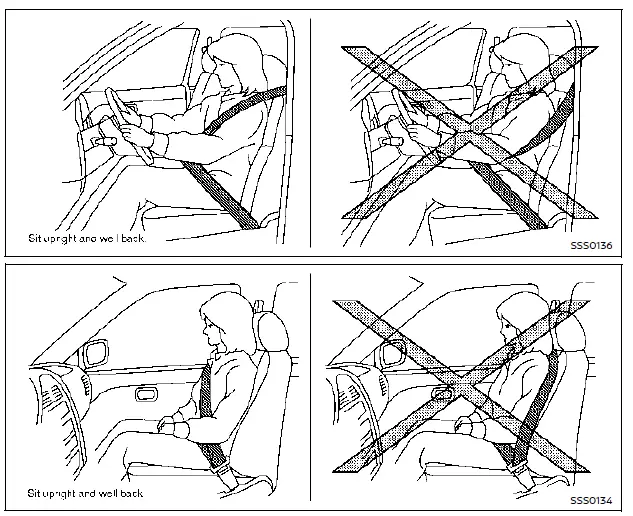
Wearing your seat belt correctly — sitting upright, positioned well back in the seat, and keeping both feet on the floor — significantly reduces the risk of injury or death in an accident. When used properly, seat belts work together with your Nissan Rogue’s safety systems, including supplemental air bags, to provide enhanced protection. NISSAN strongly urges every driver and passenger to buckle up every time the vehicle is in motion.
Most U.S. states and Canadian provinces or territories require seat belts to be worn at all times while driving.

WARNING
- Everyone riding in this vehicle must use a seat belt at all times. Children must be properly secured in the rear seat and, when appropriate, in a child restraint system.
- The seat belt must be adjusted snugly for proper protection. A loose or improperly positioned belt can reduce its effectiveness and increase the risk or severity of injury.
Severe injury or fatality may occur if the seat belt is worn incorrectly.
- Always route the shoulder belt over your shoulder and across your chest. Never place the belt behind your back, under your arm, or across your neck. Ensure it stays on your shoulder while remaining clear of your face and neck.
- Position the lap belt low and snug around the hips — NEVER the waist. A lap belt positioned too high increases the risk of internal injuries in a collision.
- Ensure the seat belt tongue clicks securely into the correct buckle.
- Do not wear the belt twisted or inside out, as this reduces its effectiveness.
- Never allow more than one person to use the same seat belt.
- Do not exceed the number of passengers for which seat belts are provided.
- If the seat belt warning light remains illuminated with the ignition ON, all doors closed, and all belts fastened, the system may require inspection.
NISSAN recommends having the system checked by a NISSAN dealer.
- Do not modify, add to, or tamper with the seat belt system. Any changes that alter belt routing or tension can compromise its proper function and may lead to serious injury.
- After a seat belt pretensioner has been activated, it must be replaced along with the retractor.
NISSAN recommends having this service performed by a NISSAN dealer.
- All seat belt assemblies, including retractors and hardware, must be inspected after any collision. NISSAN recommends this inspection be performed by a NISSAN dealer.
If the belts were in use during a collision, they should be replaced unless the impact was minor and the belts show no damage or malfunction. Belts not in use during a collision must still be inspected and replaced if damage or improper operation is found.
- All child restraints and related hardware must be inspected after a collision. Always follow the restraint manufacturer's instructions regarding inspection and replacement.
Child restraints should be replaced if any damage is detected.
Other materials:
P059f Active Grille Shutter
DTC Description
DTC DETECTION LOGICActive grille shutter normally stops within zone which is defined by zone (90°±10°).If the active grille shutter stops within zone stuck error is detected, and if the active grille shutter stops at position beyond zone overrun error is detected. DTC
CON ...
Intelligent Forward Collision Warning (I-FCW)
Basic information
WARNING
Failure to follow the warnings and instructions for proper use of the I-FCW system on the Nissan Rogue could result in serious injury or death.
The I-FCW system helps alert the driver before a potential collision but cannot prevent one. The driver must remain attentive, ...
P04f1 Evap System Purge Line
DTC Description
DTC DETECTION LOGIC DTC
CONSULT screen terms
(Trouble diagnosis content)
DTC detection condition
P04F1
00
EVAP system purge line
(EVAP System Purge Line Performance)
Diagnosis condition
During fuel cut after engine warm-up
Signal (terminal)
Mass ai ...