Nissan Rogue (T33) 2021-Present Owner’s Manual & User Guide: Front, front central*, rear outboard seat-mounted side-impact supplemental air bag and roof-mounted curtain side-impact and rollover supplemental air bag systems
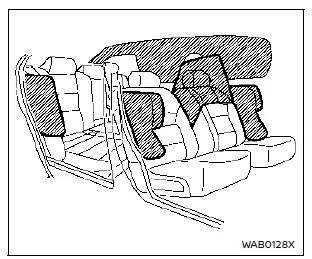
*: if so equipped
The side air bags are located on the outer side of the seatbacks of the front and rear seats. The front central side air bag (if so equipped) is located on the inner side of the driver's seatback. The curtain air bags are positioned within the side roof rails of the Nissan Rogue to help protect outboard occupants.
All warnings and cautions regarding the Supplemental Restraint System in this Owner's Manual apply to these components and must be followed. The side air bags and curtain air bags are designed to deploy in higher severity side collisions, although they may deploy in other types of impacts if the forces are similar to those of a severe side impact. These systems are intended to deploy on the side of the vehicle where the impact occurs and may not deploy in all side collisions.
Curtain air bags are also designed to deploy in certain types of rollover, or near-rollover, events. Because of this, some extreme vehicle movements (for example, during severe off-road driving or sudden maneuvers) may cause the curtain air bags to deploy.
Visible vehicle damage (or lack of damage) is not always an accurate indication of proper side air bag and curtain air bag performance.
When the side air bags and curtain air bags deploy, you may hear a loud sound followed by the release of smoke. This smoke is not harmful and does not mean there is a fire, but you should avoid inhaling it, as it may cause irritation or choking. Anyone with a history of respiratory issues should move to fresh air promptly.
Side air bags, together with correctly used seat belts, help cushion impact forces on the chest and pelvic areas of front and rear outboard occupants. The front central side air bag, in combination with seat belts, helps cushion impact forces around the head area of front occupants.
Curtain air bags help cushion impact forces to the head and upper chest areas of occupants in the front and rear outboard seating positions of the Nissan Rogue. They are designed to help reduce the risk of serious injury and can help save lives in certain side-impact or rollover collisions.
However, a deploying side air bag or curtain air bag may cause abrasions or other minor injuries. Side and curtain air bags are not designed to provide restraint for the lower body.
Seat belts must always be worn correctly, and the driver, front passenger and rear outboard occupants should sit upright and as far as practical from the side air bag modules.
Rear seat occupants should sit as far as practical from the door finishers and side roof rails. Because the side air bags and curtain air bags deploy very quickly to help protect occupants, being too close to the modules at the moment of deployment can increase the risk of injury. The side air bags deflate shortly after impact. The front central side air bag and curtain air bags remain inflated for a brief period before venting.
The side air bags and curtain air bags operate only when the ignition switch is in the ON position.
After placing the ignition switch in the ON position, the supplemental air bag warning light illuminates. The supplemental air bag warning light will turn off after about 7 seconds if the systems are operational.
WARNING
- Do not place any objects near the seatbacks of the front or rear seats. Also, do not place items such as umbrellas or bags between the front and rear door finishers, the center console, and the front or rear seats. In a collision, such objects may become dangerous projectiles and cause injury if a side air bag deploys.
- Immediately after deployment, several side air bag and curtain air bag components will be hot. Do not touch them to avoid severe burns.
- No unauthorized changes should be made to any components or wiring of the side air bag and curtain air bag systems. Doing so may cause damage or accidental deployment of these systems.
- Do not modify your vehicle's electrical system, suspension system or side panels. Such modifications could affect the correct operation of the side air bag and curtain air bag systems.
- Tampering with the side air bag system may result in serious personal injury. For example, do not modify the front or rear seats by adding material near the seatbacks or installing non-approved seat covers or trim around the side air bag areas.
- Removing or altering the front or rear passenger seats may affect air bag performance and result in serious personal injury.
- It is recommended you visit a
NISSAN dealer for any work on or
near the side air bag and
curtain air bag. It is also recommended
you visit a NISSAN dealer
for installation of any additional electrical equipment.
The Supplemental Restraint System (SRS) wiring harnesses* must not be modified or disconnected. Unauthorized test equipment and probing devices must not be used on the side air bag or curtain air bag systems.
*The SRS wiring harness connectors are yellow and orange for easy identification.
When selling your Nissan Rogue, please inform the new owner about the side air bag and curtain air bag systems and direct them to the appropriate safety sections in this Owner's Manual.
Other materials:
B24a4-11 Intake Sensor
DTC Description
DTC DETECTION LOGIC DTC No.
CONSULT screen terms
(Trouble diagnosis content) DTC detection condition
B24A4-11
INTAKE SENSOR
(Intake sensor)
Diagnosis condition
Ignition switch ON
Signal (Terminal)
Intake sensor signal
Threshold
The intake sensor rec ...
Conventional (fixed speed) cruise control
Basic information
Conventional (fixed speed) cruise control is available as an alternative to Intelligent Cruise Control. To activate the conventional cruise control mode in the Nissan Rogue:
Example
1. Push and hold the ProPILOT Assist switch A for longer than approximately 1.5 seconds.
2. Once ...
P0130 A/f Sensor 1
DTC Description
DTC DETECTION LOGICTo judge the malfunction, the
diagnosis checks that the A/F signal computed by ECM from the A/F sensor
1 signal fluctuates according to fuel feedback control. DTC
CONSULT screen terms
(Trouble diagnosis content)
DTC detection condition
P0130
00 ...